Fuel has hit a new peak, and from 28th September Eni will sell it for up to 17 cents less per litre. But in the Abruzzo hinterland, the price on the sign is only half the story. The other half is how far you have to drive to reach it. The good news: with a little planning, it is easy to manage, and one village has already shown how.
Why Our Pumps Matter
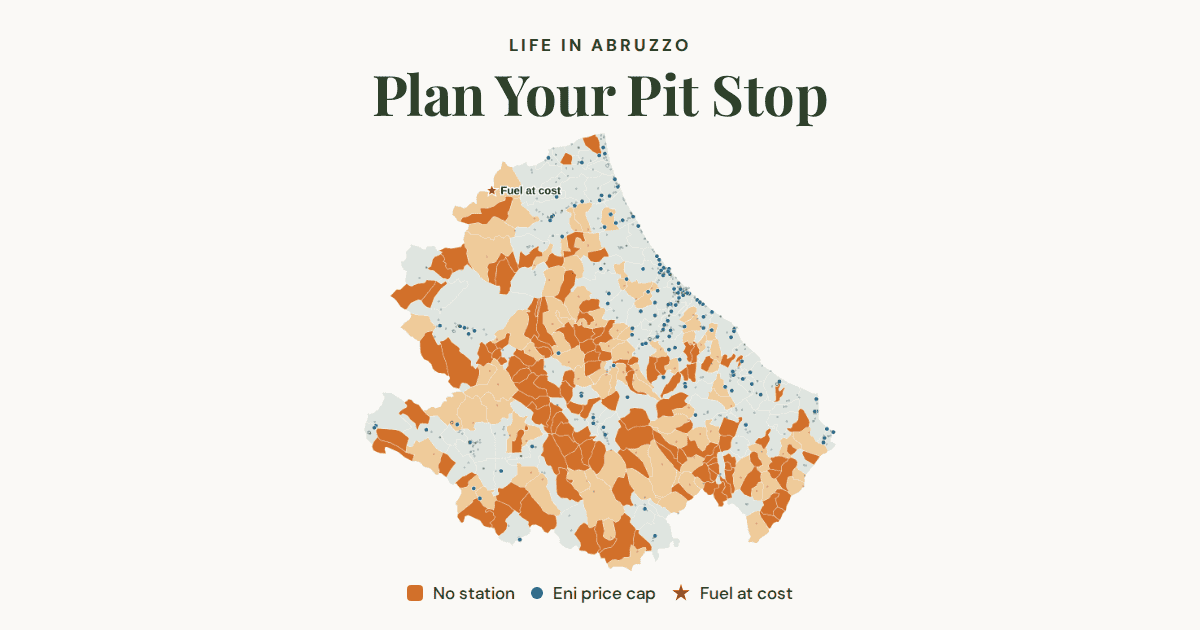
As our villages have thinned out, shops and schools have closed, and petrol stations have followed. Today 122 of Abruzzo’s 305 comuni have no petrol station at all.
Since 2011, the comuni with no pump have lost about one resident in seven, more than four times the rate for Abruzzo as a whole. Around 86,500 people still live in them, and keeping a pump open is part of keeping a village alive.
I feel it myself. From my village of Bascianella, my nearest pump is now 10 km away by road, and the next is almost 13. I am far from the worst off. The drive to the nearest pump from some of our best-known hill villages:
• Campotosto: 21 km
• Pietracamela: 18 km
• Ceppo: 17 km
• Santo Stefano di Sessanio: 15 km
• Roccacaramanico: 14 km
On the map, tap a pump, then open the Google Map link see the real drive.
(To see the map on a full page, click here)
What it Now Costs
We manage, and so can you. But the American, Israeli, and Iranian war has pushed petrol to around €2.15 a litre and diesel to around €2.40 (about $9 and $10 a gallon). And with winter coming, those off the gas network will feel it twice: the heating oil and LPG that warm our homes follow the same markets.
- Every trip to fill up now has to be costed in. A 10 km or 16 km drive each way just to reach a pump is no longer small change.
- Businesses pass it on. The plumber, the builder and the delivery van all drive those same roads, and the fuel ends up on the customer’s bill.
- The coast is hurting too. Fishing fleets say fuel has doubled for their boats, and plan to strike on 22 October.
- From 28th September, Eni is capping its prices at €1.99 for petrol and €2.19 for diesel. Last week, that was almost exactly the price at Valle Castellana’s comune-run pump (more on that below). The catch: there are few Eni stations in the mountains.
- Italy has asked the EU to tax oil companies’ war windfall, but so far no tax has been agreed, in Brussels or in Rome.
The Best-Laid Plans: When Your Pump Runs Dry
In Mary Poppins, young Michael Banks shouts in the bank that he wants his tuppence back. Everyone hears, everyone panics, everyone demands their money at once, and the bank has to close its doors. Fuel works the same way. When prices jump, or a discount appears, drivers rush the cheapest pump, and its tanks run dry. It happened this March, when stations across northern Italy put up “fuel sold out” signs as drivers chased the lowest prices. In a town, you drive round the corner to the next one. Up here, a rush on your local pump means a longer drive, more time and more fuel just to fill up at the next best. From Campotosto, the nearest pump is already 21 km away at Montereale; if that one runs dry, the next is 31 km away at Crognaleto. The answer is simple: keep your tank above half, and a rush never catches you empty.
Buying a House? How to Plan For Fuel
None of this is a reason not to buy in the hills. It is a reason to buy with your eyes open. Before you commit:
- Check the drive, not the map. Tap the house on our map, pick two nearby pumps and check the real drive to each in Google Maps. The pump that looks nearest on the map is often not the nearest by road.
- Know your backup. If your nearest pump closes or runs dry, where is the next one?
- Look at the village, not just the house. A village pump survives only if enough people use it, and no company runs one at a loss forever. A lively village is a safer bet than a shrinking one.
- Ask about winter. Neighbours will tell you which roads close after snow or landslides.
- Budget for it. Add your weekly drives and your heating to the running costs before you make an offer on a house.
Once you are here, a few habits make it easy:
- Never let the tank run low. Fill up when it hits half, especially before a long weekend or a storm.
- Combine the trip. Fill up on the way to the supermarket, the doctor or the station, never as a journey of its own.
- Share the load. Car-share the school run and the big shop with neighbours.
- Keep an eye on prices. The ministry’s Osservaprezzi site shows every pump’s price, so you can time your fill-up for the cheapest one on your route.
- Carry €20 in cash. Self-service pumps usually hold around €100 on your card before you fill up, and release what you don’t use only after a day or two, sometimes longer. If you don’t always have that much spare in your account, or the card machine is down, cash still gets you home.
Not Like Where You Left
In Britain and America, the petrol pump is a convenience. It sits beside the supermarket, and you shop and fill up in one trip. Here that is rarely possible. The pump is one journey, the shop another, the doctor a third.
Our mountains are fragile. The extreme weather of the climate emergency brings storms and landslides that can close a road for months, turning a quick run for fuel into an hour’s detour.
We saw it only this April, when Cyclone Erminio brought floods across the region. Landslides struck Chieti, Vasto and even Valle Castellana; several villages were cut off, and some families had to leave their homes. Anas closed state roads across Abruzzo; Lanciano alone shut 14 roads; the Adriatic railway was cut, and the bridge carrying the SS16 over the Trigno, a main link between Abruzzo and Molise, collapsed.
Mountains move. In August, a glacier and mountainside collapsed above Nepal’s Langtang valley, a disaster scientists link to Himalayan ice melting as the climate warms, and the torrent that followed swept away villages, bridges and the main road to China. Abruzzo has lived its own version: on 5 September 1955, during a violent storm, part of the mountain gave way above Villa San Sebastiano, near Tagliacozzo. Huge boulders, water and mud buried much of the village, killing four people, and it had to be rebuilt lower down. With El Niño forecast to become very strong this winter, raising the risk of extreme weather worldwide into 2027, one closed road could cut you off from your nearest pump just when fuel is at its dearest. A full tank, and knowing a second route to a second pump, is the simplest insurance there is.
The Good News: Villages Can Fix This
Valle Castellana shows what a small comune can do. When its only pump was about to close, the village bought it for around €50,000 and now sells fuel at cost. Neighbours drive over to fill up, other mayors are asking how to copy it, and this week one of Europe’s biggest oil companies set its prices at almost the same level.
If your village has lost its pump, or is about to, ask your mayor whether the same could work for you.
And tell us your drive. How far is your nearest pump, by road, from your house? Send us your village and your distance, and we will add the best examples to the map.
Frequently Asked Questions
How many towns in Abruzzo have no petrol station?
122 of Abruzzo’s 305 comuni had no petrol station in the ministry’s register of active stations on 26 September 2026. Another 85 had only one.
How far is the nearest petrol station from Abruzzo’s hill villages?
Often 15 to 20 km by road. In September 2026 it was about 21 km from Campotosto, 18 km from Pietracamela and 15 km from Santo Stefano di Sessanio. Inland, the drive is often two or three times the distance as the crow flies.
Why is fuel so expensive in Italy in 2026?
The American, Israeli and Iranian war has kept oil scarce and expensive all year. On 26 September 2026, the Italian government also halved its diesel tax discount.
How much is petrol in Italy in dollars per gallon?
In late September 2026, about $9 a gallon for petrol and $10 a gallon for diesel.
Which petrol stations are cheapest in Abruzzo?
From 28 September 2026, Eni stations cap petrol at €1.99 and diesel at €2.19 a litre for at least a month. Abruzzo has 142 Eni stations, but few in the mountains.
What is the mayor’s petrol pump in Valle Castellana?
A petrol station the comune of Valle Castellana, in the province of Teramo, bought to stop it closing. It sells fuel at cost, with no profit on top, read our article
What should I check about fuel before buying a house in Abruzzo?
Check the real driving distance to the nearest pump, where the next one is if it closes or runs dry, how many people live in the village, and which roads close in winter.
How we Did it
The map uses the Ministry of Enterprises’ official register of active petrol stations, dated 26 September 2026. Driving distances and times come from Google Maps. Dollar prices use the exchange rate of 25 September. Population figures are ISTAT resident counts for 2024, compared with the 2011 census.

Alongside raising a teenager, Sam hosts guests at her family’s traditional home, the Little House of the Firefly in Abruzzo, offering a warm welcome and insider tips on local culture, food, and hidden gems.

Author: Sam Dunham
Sam is a freelance SEO content creator and IGCSE Geography and English teacher in Rome. She also runs the Life In Abruzzo Cultural Association, sharing stories and insights about this captivating region. Alongside raising a teenager, Sam hosts guests at her family’s traditional home, the Little House of the Firefly in Abruzzo, offering a warm welcome and insider tips on local culture, food, and hidden gems.