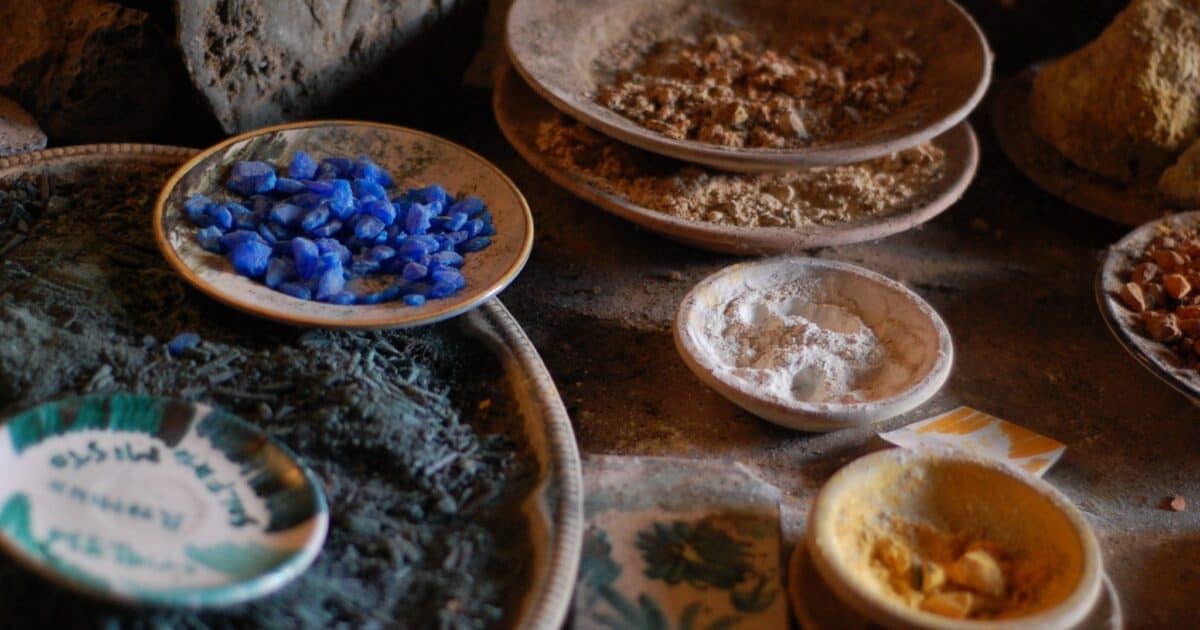
Castelli ceramic pigments and a working tile in an artisan studio. The de Pompeis family has been part of the Castelli tradition since the 1490s © Sam Dunham
Pescara Civic Action Laid Bare
Two men were central to Pescara’s development. Although they were born sixty-eight years apart, both left lasting marks that remain in the city today.
The first man was born in Pescara in 1863 to a wealthy family in the small riverside town. He moved to Rome as soon as possible and became a famous poet across Italy by age twenty-five. He worked hard to make his name known. When he returned to Pescara, he wrote to Mussolini, asking that a new Province of Pescara be created from Chieti and Teramo, with his birthplace at its centre. Mussolini agreed.
Sixty-eight years later, the second man was born in Fiume, a port city on the Adriatic now called Rijeka, Croatia. At that time, Fiume was under Italian rule and had a strong Italian-speaking community. His parents were professionals from Abruzzo, and their family had lived there for five centuries. After the war, when Tito’s Yugoslavia took control of Fiume, his family had to leave. He returned to Abruzzo, became a doctor, and spent his life working to improve the region his family had always called home.
The first man was Gabriele d’Annunzio. The second was Claudio Leno de Pompeis. Pescara still honours d’Annunzio by naming the university, streets, and tourist materials after him. Most visitors do not know de Pompeis, but the museum he started still teaches local students and welcomes visitors from abroad every week.
This is the story of what each man created and what their work shows us about civic action, both in the past and now.
Roots
D’Annunzio came from a story he had carefully edited.
His real paternal grandfather was Camillo Rapagnetta, a shoemaker in Pescara. Both the Rapagnetta and the d’Annunzio paternal lines came from Le Marche, the region just north of Abruzzo. Why they came south is not on the public record. They were not patrons of culture. They were ordinary working families looking for a living in a small Adriatic town that was itself just emerging from its status as a malarial fortress prison, as the first piece in this series showed.
The d’Annunzio surname itself came from a mistake. Nearly three hundred years ago, an official at the registry of deaths in Pescara wrote “Giuseppe D’Annunzio” instead of “Giuseppe Nunzi”. The new spelling stuck. His descendants kept the name.
In Italian Catholic ears, the name carries unmistakable religious weight. “D’Annunzio” means “of the Annunciation”. The Annunciation is the moment in the Christian story when the angel Gabriel tells Mary she will bear the Son of God. The poet’s parents had also given him the angel’s first name. Gabriele d’Annunzio, read in Italian, is the entire Annunciation in two words. The clerical mistake from three hundred years earlier had handed the family a quasi-biblical surname.
The two family lines met through a marriage. Antonio d’Annunzio, a rich merchant and shipowner from the clerical-error line, married Anna Lolli, a member of the Pescara middle class. They had no children. Her sister Rita Olimpia Lolli married Camillo Rapagnetta, the shoemaker. They had six. In 1851, a court in L’Aquila ruled that the sisters’ deal could stand: the sixth Rapagnetta child, thirteen-year-old Francesco Paolo, was adopted by his maternal aunt and her rich husband. Francesco Paolo took the surname Rapagnetta-d’Annunzio. He also took the d’Annunzio money.
He served as Mayor of Pescara from 1879 to 1881. He pushed urban expansion during his short mayoralty. Pescara was already on the new Adriatic railway, and the metal bridge over the river would follow in the 1890s. Whatever the family’s role in any specific project, the city’s growth raised the value of family land. In three generations, the Rapagnetta family had done well from internal migration. Camillo’s shoemaking was honest work. The Lolli marriages brought the family into the Pescara middle class. The d’Annunzio adoption and the mayoralty made them notables. His son Gabriele was born in 1863 as Gabriele Rapagnetta-d’Annunzio. The shoemaker, Camillo, was the witness on the birth registration.
Within twenty years, Gabriele had cut “Rapagnetta” from his public name. The film editor was already at work. The shoemaker grandfather. The modest Marche roots. The registry error that created the name in the first place. The adoption deed that funded the family’s wealth. None of it made the final cut. What he kept was the half that sounded like the angel Gabriel announcing the Annunciation. The version of himself that reached the world was the polished one. The actual stock, working people from Le Marche making shoes in a small Adriatic town, stayed on the cutting room floor.
The de Pompeis Family had been in Abruzzo for five centuries.
Their original surname was Pompei. The family’s founder, Orazio Pompei, was a master majolica painter in Castelli, at the foot of Gran Sasso, in the late 1400s. Castelli was the centre of Italian ceramic art at the time. Its kilns produced maioliche, painted majolica ceramics, that decorated the palaces of the Aragona, the Orsini, and the Farnese. Orazio Pompei’s workshop was at the heart of all this.
Around 1600, Lorenzo de Pompeis moved from Castelli to Torre de’ Passeri. The Marquis Mazara supported the move. Lorenzo set up a new ceramic workshop using the valley’s water and clay. The family bought land across the surrounding hills, including Madonna degli Angeli, where the farm still operates as an agritourism business today. A century later, the family built the Palazzo de Pompeis on Piazza Plebiscito, on the very site of Lorenzo’s original workshop. The palazzo is still standing. It is now a national monument and houses a family foundation.
For four centuries, the de Pompeis family stayed put. They hosted Carbonari conspirators on their way north. The Carbonari were a secret society that worked for Italian independence and unification in the early 1800s. The de Pompeis family also hosted King Joachim Murat in 1815. They hosted the British and French generals Chervardes and Howard. The family archives sat in the house’s alcove. Over the centuries, the family had moved from artisans to professionals: from the ceramic workshops at Castelli, to landowning at Torre de’ Passeri, to medicine. By the time of Claudio’s generation, the men of the family were doctors who dug at archaeological sites in their spare time.
Both families built things in Pescara. The d’Annunzio family pulled the small Adriatic town into the industrial age and made themselves notables in the process.
The de Pompeis family built a different kind of continuity. A century of Castelli ceramic tradition, then medicine and recording the world around them. The family’s cultural identity stayed rooted in the region.
Two ways of building in one city. Both real. Both consequential. The difference between them will matter later.
Turning Points
 D’Annunzio’s turning point came in Rome at the age of twenty-two. He had published his first book of poems at sixteen. He was already a prodigy. In Rome, he decided to invent himself as a public figure. He started affairs, gave himself titles. He managed his press coverage carefully. He planned the scandals. He gave himself the name “il Vate”, the Bard. He insisted on it. He started doing this in his twenties and never stopped.
This was the moment d’Annunzio decided that he himself was the subject. Pescara, Italy, women, politics, war, even fascism: all of it became raw material for d’Annunzio’s production. The word for this is narcissism. The word is not a modern judgement. People at the time used this word. He made himself the centre of every room he entered. Slowly, he made himself the centre of every room he was not in.
De Pompeis’s turning point came on Monte Velino. He was hiking when he came down with bronchitis. He could not get back down the mountain. Some shepherds found him. They took him to a cave where they were sheltering. They looked after him for several days. They walked him out when he was well enough to move.
The story is on the public record. An Il Centro article, published ten years after his death, tells it directly. He was, the article says, “struck by the human solidarity and the deep values of these people.” He later described them in the museum displays he spent the rest of his life building.
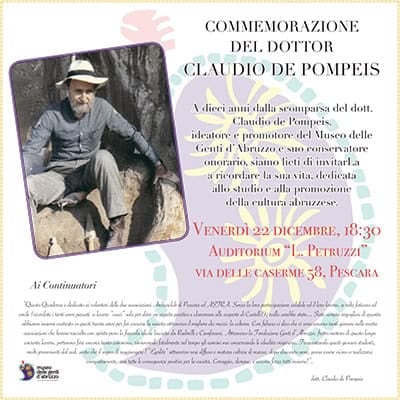 This was the moment de Pompeis decided that other people were the subject. The shepherds. The farm workers. The crafts and seasonal customs of the Abruzzese peasant world, to which his family had always belonged. He had grown up in Fiume, in a Central European culture shaped by the old Austro-Hungarian empire. He came home to find that ordinary working Abruzzesi had saved his life. He spent the next forty years working out what he owed them.
Two turning points. One man looked at himself. The other looked at the people around him. D’Annunzio would spend his life producing a theatre of Abruzzese culture, using the parts of it that suited his own performance. De Pompeis would spend his life doing the slower work of anthropology: meeting the shepherds, recording their crafts, digging the kilns, documenting what was actually there. Both then acted on what they saw.
The Fiume Bridge
A strange piece of history connects the two men.
By 1919, d’Annunzio was fifty-six years old. He had served three years in the Italian Chamber of Deputies as an independent. By 1910, his daredevil lifestyle had run up so much debt that he had to flee Italy and live in France to escape his creditors. He returned to Italy when the First World War broke out and spent the war years on celebrated military exploits. He was decorated repeatedly as a Lieutenant Colonel of Cavalry. His most famous stunt was a 1918 propaganda flight over Vienna to drop leaflets on the enemy capital. By the end of the war, he was one of Italy’s most celebrated war heroes.
The war was over. He was looking for the next stage.
A group of Italian Army officers at Ronchi, near Trieste, wrote to him in late August 1919. They were grenadiers of the Sardinia Brigade who had been part of the Fiume garrison and had been ordered out of the city. They wanted to go back. They asked the famous war hero to lead them. He agreed. On 12 September 1919, d’Annunzio led around two and a half thousand Italian nationalist soldiers into Fiume. Many of them were recent veterans of the First World War. After Austria-Hungary had collapsed at the end of the war, the city’s future was up for grabs. The Treaty of Versailles assigned it to the new Kingdom of Yugoslavia. Italian nationalists rejected this. They called it part of the “mutilated victory” that had cheated Italy of land they thought was rightly Italian.
D’Annunzio held no official position. The Italian government did not authorise what he did. He invaded the city anyway. He declared himself Comandante, the Commander. He ran Fiume for fifteen months as a personal mini-state. He called it the Italian Regency of Carnaro.
The occupation was theatre. D’Annunzio gave speeches from the balcony every night. He designed the uniforms. He invented the slogans and the salutes that Mussolini would later borrow for fascism. He also pioneered a particular form of political violence: forcing his opponents to swallow large doses of castor oil. The dose acted as a powerful laxative. It humiliated, disabled, and sometimes killed those forced to drink it. Mussolini’s Blackshirts later used the same method as a standard tool of political terror across Italy in the 1920s. D’Annunzio held court for the celebrities, journalists, poets, and adventurers who arrived to be part of the show. The whole production was a stage built so that d’Annunzio could stand at its centre.
The Italian Navy finally put an end to the show. In December 1920, they shelled his headquarters on Christmas. He left Fiume soon after. But the political damage was done. In January 1924, Italy and the new Kingdom of Yugoslavia signed the Treaty of Rome. Mussolini, who had been Prime Minister since October 1922, signed it himself. The treaty was his first foreign-policy victory and his first expansion of Italian territory. He was not yet a dictator. That would come a year later, after the murder of the Socialist deputy Matteotti. The treaty gave the city of Fiume to Italy and the adjacent port suburb of Sušak to Yugoslavia.
An Italian administration moved into Fiume. The new posts drew Italian professionals from across the country. Doctors, teachers, civil servants and engineers were among those who went. For a young Italian professional, this was a real career option. Posts that took years to win in Italy were available straight away, and you could still work in Italian.
This was the same period when millions of Abruzzesi were leaving for the Americas and Australia: those families went to countries where the children would have to learn a new language to get on. Fiume offered a rare destination where an Abruzzese could chase a career opportunity without leaving the Italian-speaking world.
This was different from what Mussolini’s regime would later organise in Libya and Italian East Africa. Those were full colonial settlement schemes that moved Italian families onto land taken from local populations. The regime built around twenty-six Italian agricultural villages across Italian Libya, each named after a fascist hero or martyr. One of them, built in 1938, was Villaggio D’Annunzio. It held 560 Italian settlers across 1,700 hectares of expropriated land. The poet had died that March. He did not live to see his name on a colonial village, but the regime that had taken his iconography for fascism also took his brand for its expansion into Africa. Fiume was not that.
Claudio de Pompeis was born in Italian Fiume on 25 March 1931. His parents were Abruzzesi. His father was a doctor, part of the wave of Italian professionals who had moved east under the new administration.
In 1947, the Treaty of Paris gave Fiume to Yugoslavia. Tito’s regime threw out the Italian population. The de Pompeis family was among them. They came home to Abruzzo.
The two lives connected through one Adriatic city. The Treaty of Rome, an international agreement between Italy and Yugoslavia, was what made Fiume Italian and brought professionals like Claudio’s father east. D’Annunzio’s 1919 occupation was one chapter in the longer story that led to that treaty. He was not the only cause. But he was the most visible Italian figure on the Fiume stage, and the political pressure of his fifteen-month performance helped move the diplomatic process toward the eventual annexation. One man used the city as a stage in 1919. The other was born there in 1931 under the subsequent Italian administration. The Yugoslav victory in the Second World War sent the family home.
What Each Man Built
D’Annunzio built his celebrity. Across fifty years of public life, he produced novels, poems, plays, political speeches, military stunts, scandalous affairs, and the fancy physical changes he made to his own face and body. The work was real. The work was also entirely about him. And the persona, in the end, was funded on borrowed money.
In 1924, d’Annunzio wrote personally to Mussolini, asking him to create a new Province of Pescara, carved out of the existing provinces of Chieti and Teramo. Mussolini agreed. The 1927 royal decree created the new Province with d’Annunzio’s birthplace at its centre. In the same year, a second royal decree declared the Casa d’Annunzio, the poet’s birthplace, a national monument. Mussolini sent the poet a telegram confirming the decisions, addressed to “your Pescara”. The Province of Pescara exists because a famous Pescarese asked his political patron for it, and the patron said yes. The poet’s lobbying had real consequences for family land near what was about to become the new administrative core, as the first piece in this series showed.
He spent his final years at the Vittoriale degli Italiani at Gardone Riviera on Lake Garda. The Vittoriale is the ultimate expression of d’Annunzio’s project. It is a huge mansion built entirely as a monument to himself. The bow of the warship Puglia is mounted in the garden. The rooms are dedicated to his own image. The tomb where he is buried is staged like a theatre set. There is no civic function. There is no public service. There is no honouring of anyone except him.
De Pompeis built institutions.
He worked as a doctor. He rose to the rank of Primario, head of the Occupational Medicine service at the Pescara health authority. He looked after the health of working people. Everything else he did was unpaid, in his spare time, with volunteers.
In 1970, he gathered the first group of citizen archaeologists in Pescara. In April 1971, he founded the Archeoclub di Pescara. He also joined the founding committee of Archeoclub d’Italia. His membership card was number 2. In February 1972, he refounded the Astra, the regional association for the study of Abruzzese popular traditions. In May 1973, he opened the first version of his museum in the storehouses under the Casa d’Annunzio on Corso Manthonè. Two visions of Abruzzese identity now shared the same building.
Through the 1980s, he discovered a previously unknown Neolithic culture. He named it the Cultura di Catignano. He spent ten years digging at the Castelli kilns. He proved that many Renaissance majolica pieces displayed in museums around the world, previously attributed to Faenza, were actually from Castelli. He was digging in the village where his own family had founded the European ceramic art tradition. The international exhibition that followed forced major museums to change their labels.
In 1982, the Comune di Pescara, the city council, bought the Bagno Borbonico, the former Bourbon prison, from the State for the symbolic price of seventy million lire. It was designated as the new home of his museum. In 1991, the first seven rooms opened. In 2003, the full fifteen thematic areas were finished. In 1997, the Fondazione Genti d’Abruzzo was set up with bipartisan support to ensure the institution would outlast its founder.
De Pompeis died on 18 November 2007. He left an “Appeal to continuators” in Quaderno number 32 of the museum’s published series. It was his last formal text. The Museum continues. The Fondazione continues. The volunteers continue.
What They Refused
D’Annunzio refused to be modest. He refused to stop seeking attention. He refused to build anything that was not about him. The narcissism was not an accident of personality. It was a working method. He made it visible. He demanded it be photographed. He made sure the photographs were sent out.
De Pompeis refused other things. He refused to put his name on the museum. The institution is called the Museum of the Peoples of Abruzzo. Plural. About them. He refused to lobby for monuments to himself. He refused to write memoirs to glorify himself. He refused to make himself the subject of the project. After his death, the Pescara city council dedicated the museum to his memory, but the name he had chosen for it stayed. In the founding documents and in the things written about him, he is described as a citizen, “cittadino”, with the same word he chose for himself. Not a scholar. Not an intellectual. Not noble. A citizen.
Civic action is not just what you do. It is also what you refuse to do.
Discussion Points
There is a legitimate defence of d’Annunzio. His literary work shaped Italian modernism. The province he asked Mussolini to create has benefited many people with no connection to his family. Those facts stand.
There is also conduct that is not defensible. The castor oil torture of political opponents. The proto-fascist salutes and slogans that Mussolini’s Blackshirts then used in the streets. The brand was attached to a colonial village built on expropriated African land in 1938. Most readers do not know about these things. They are part of the record. This piece has shown them in plain sight.
The Egalité Testament
When de Pompeis died, the Museum published his last text. It is one of the more remarkable civic documents to emerge from Abruzzo in recent decades.
He thanked the volunteers of the Archeoclub and the Astra. He reminded them of the years they had spent washing pottery shards from the Castelli digs. He told them to be proud of what they had built together. He pointed to the young students arriving in their associations, many from the south. Through them, he said, and through the Fondazione, the work would go on. The people doing the work would change. The original ideals would stay.
Then he wrote the line that gives this piece its frame: “I feel that the dream of reaching Egalité through a diffused and mature mass culture, after two hundred years, can be near to being fulfilled, with all the positive consequences for society. Courage, then, and once again strength all together.”
The reference is direct. Two hundred years before 2007 was 1789. The French Revolution. The Enlightenment. The new world the revolutionaries promised was captured in three French words: liberté, égalité, fraternité. Freedom, equality, brotherhood. The middle one, equality, was de Pompeis’s whole civic philosophy in a word. The museum was the tool. The volunteers were the method. The continuators were the future.
That is what a civic builder leaves behind when he is not a narcissist. Not a monument to himself. A working philosophy with an institution attached, and a request that other people carry it forward.
What Each Teaches
People mention D’Annunzio’s name again and again. You hear it at the university, see it on street signs, find it in tourism brochures, and notice it in speeches by politicians who want to honour a famous local figure.
Even Mussolini used D’Annunzio’s name. By 1927, as dictator, he declared the Casa d’Annunzio, the poet’s birthplace on Corso Manthonè, a national monument. His regime, known for castor oil and Blackshirt violence, wanted cultural respectability. They needed the support of educated people and those who valued literature. For them, D’Annunzio’s birthplace became a kind of shrine.
The Palazzo de Pompeis in Torre de’ Passeri has the same legal status, earned through four centuries of family dedication.
In 1973, the de Pompeis museum opened in the storehouses beneath the same building. For eighteen years, two views of Abruzzese culture shared the address: the official shrine was upstairs, while the people’s museum was downstairs. In 1991, the de Pompeis museum moved up the road to the Bagno Borbonico, a former Bourbon prison, where it still stands today.
The museum is named The Peoples of Abruzzo. Over time, it has become a rich collection. Italian schoolchildren visit on field trips to learn about farming cycles, seasonal migrations, crafts, folk medicine, household tools, and old customs and rites. They discover the trades their grandparents practised before industrialisation. Visitors from abroad who are tracing their roots find the world of their ancestors preserved and explained. Volunteers continue this important work.
Claudio left behind three sons.
Ermanno de Pompeis is now the Conservatore of the Museo delle Genti d’Abruzzo in Pescara, the museum his father founded. He served as its Director from 1999 to 2017 and received the title of Cavaliere dell’Ordine al Merito della Repubblica Italiana for his cultural contributions.
Vincenzo de Pompeis spent many years as President of the Fondazione dei Musei Civici di Loreto Aprutino, which manages the Museo Acerbo and its world-class collection of Castelli baroque maiolica. In 2017, he invited British photographer Michael Kenna to Abruzzo for an exhibition and a book.
Lorenzo de Pompeis manages Madonna degli Angeli, the family farm in Tocco da Casauria, where the de Pompeis family has lived since about 1600. Today, it is an agriturismo where visitors can hear stories from the family and the region.
This is a family dedicated to service. They do it in different ways, but the purpose remains the same.
If you visit Pescara, take a walk through the old town. The Casa d’Annunzio and the Bagno Borbonico are just a few minutes apart. Both places still have a purpose, but each represents a different idea of who culture is meant to serve.
Where to Find Them
Museo delle Genti d’Abruzzo: Via delle Caserme 24, Pescara · gentidabruzzo.com
Casa Natale di D’Annunzio: Corso Manthonè 116, Pescara · casadannunzio.beniculturali.it
Palazzo de Pompeis: Piazza Plebiscito 12, Torre de’ Passeri (PE)
Madonna degli Angeli: Contrada Madonna degli Angeli, Tocco da Casauria (PE) · madonnadegliangeli.com

Alongside raising a teenager, Sam hosts guests at her family’s traditional home, the Little House of the Firefly in Abruzzo, offering a warm welcome and insider tips on local culture, food, and hidden gems.

Author: Sam Dunham
Sam is a freelance SEO content creator and IGCSE Geography and English teacher in Rome. She also runs the Life In Abruzzo Cultural Association, sharing stories and insights about this captivating region. Alongside raising a teenager, Sam hosts guests at her family’s traditional home, the Little House of the Firefly in Abruzzo, offering a warm welcome and insider tips on local culture, food, and hidden gems.