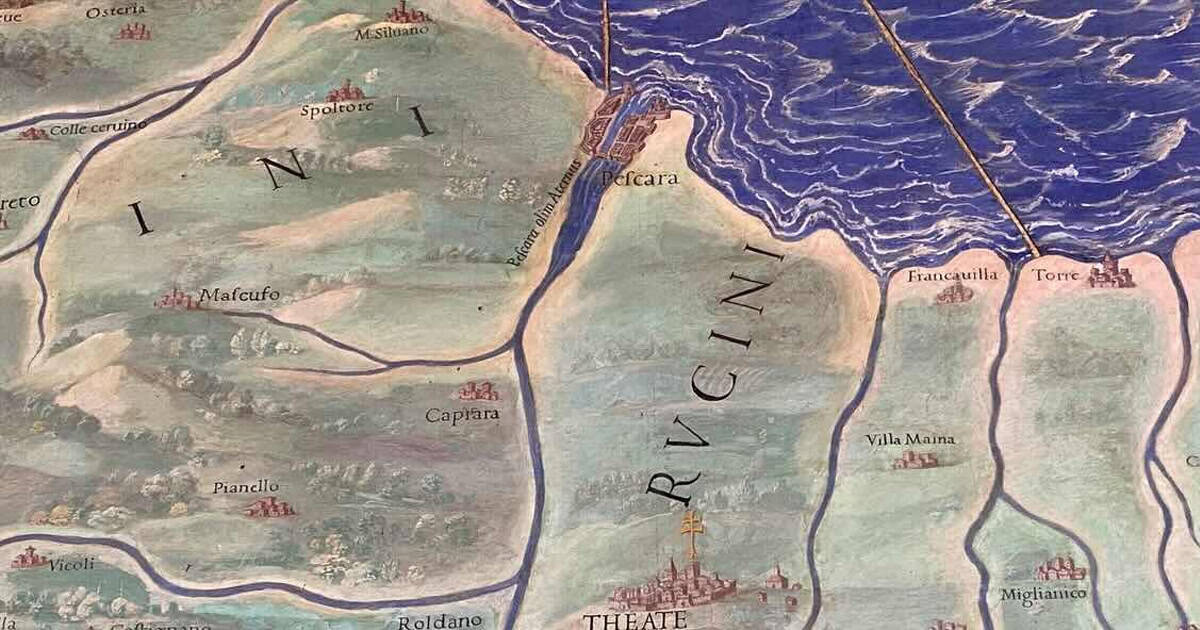
Galleria delle Carte Geografiche, Vatican Museum
Abruzzo’s youngest provincial capital stands where a river has shaped life for two thousand years, sometimes drawing people in and sometimes pushing them away. This is the story of how it became a city.
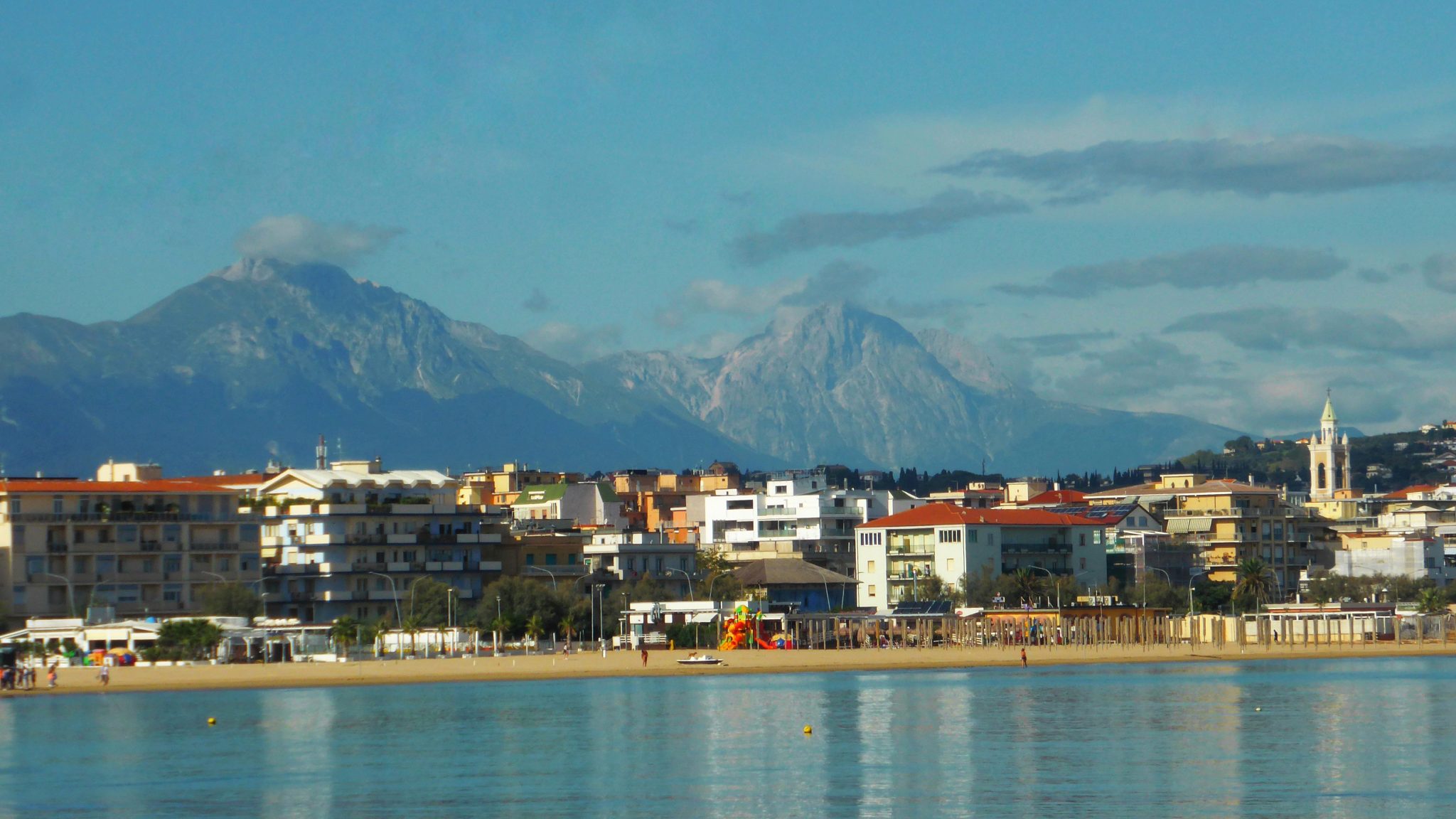
The Pescara you see today is younger than your great-grandparents. This flat city of about 118,000 people sits on Italy’s Adriatic coast, just east of Rome. It’s known for its modern style, ring roads, beach umbrellas, and the long, straight Corso. Pescara officially became a city on January 2, 1927. Before that, no single municipality called Pescara covered both sides of the river. For most of the 1800s, two separate towns split the river mouth: Pescara on the south bank and Castellammare Adriatico on the north. Mussolini’s government joined them, creating one coastal city from the two.
That’s the simple version. The real story is more interesting, and it all starts with the river that gave the city its name.
The Name and the River
The city is named after the river that runs through it. In medieval documents from the 1140s onwards, the river was called Piscaria, the Latin word for a fish-rich place. The walled fishing village that grew up on its south bank took its name from the river. Over the centuries, Latin Piscaria softened into Italian Pescara. The fish were the reason to live near the river. The mosquitoes, as we will see, were the reason to live away from it. The history of the place is the tension between those two facts.
The Site that Resisted Growth
The mouth of the Pescara River is one of the few natural harbours along the Adriatic between Ancona and the Gargano Peninsula. It could have grown into a major city before Naples or Bari became important. Instead, for nearly two thousand years, the towns here stayed small and often struggled to survive. There are three main reasons why.
The first reason was malaria. The lower Pescara valley was a marshy delta where the river met the sea, with mountain water spreading over flat land. Anopheles mosquitoes thrived there. Until the 1800s, anyone living at the river mouth year-round risked dying young. So, the main towns in Abruzzo grew in the safer hills. For a long time, Pescara’s flat coastal location was more a problem than an advantage.
The second reason was the river itself. The Pescara was an unpredictable lowland river that often flooded, filled with silt, and changed course. The Roman bridge at Aternum, the old name for the settlement at the river mouth, had to be rebuilt many times. The port at the estuary worked but only with constant repairs, dredging, and rebuilding. Every group that ruled the river mouth had to keep fighting the river’s changes.
The third reason was the raiders. From late antiquity onward, the Adriatic coast faced attacks from Slavic pirates, North African corsairs, Saracens, Ottomans, and Dalmatian sea raiders. Coastal towns without strong walls or natural defences were easy targets. While hill towns survived, coastal settlements were often abandoned, attacked, and rebuilt many times.
Before Rome: the Italic Tribes
Long before all this, the area belonged to the Vestini and the Marrucini, two main Italic peoples in pre-Roman Abruzzo. The Vestini lived along the coast and in the Gran Sasso foothills, with their main centre at Pinna (now Penne). The Marrucini lived just south, around modern Chieti, with their capital at Teate Marrucinorum. The Pescara River was roughly the border between them. In 91 BC, both tribes joined the Marsi and the Paeligni in the Social War against Rome. Their goal was unusual; they wanted to become Roman citizens, not break away. By 87 BC, they had succeeded.
Roman Aternum to Medieval Emptiness
A Roman trading port called Aternum stood at the river mouth on the south bank. It shipped olive oil, wine, wool, and timber from the mountains inland. Strabo, writing in the first century BC, described it as the main outlet for the inland Italic peoples. Aternum was the endpoint of the Via Claudia Valeria, the Roman road from Rome through Tivoli and Corfinium. Still, it was a modest place. The main Roman cities were inland: Teate Marrucinorum (Chieti), Interpromium, and Corfinium. Aternum was a busy port, but not a major city.
The Lombards destroyed Aternum in 597 AD. For the next five centuries, the area was mostly empty except for fishermen and a few military outposts. During this period, much of Abruzzo’s Adriatic coast lost its towns and cities. The hill towns survived, but the coast was left nearly deserted.
In the eleventh century, a walled fishing village appeared again. It took the river’s name and managed to survive, relying on what the river and sea could offer.
The Spanish Fortress and the Bourbon Prison

Between 1510 and 1557, the Spanish, under Emperor Charles V, turned the village into a fortified stronghold. The Fortezza di Pescara straddled both banks of the river, joined by a permanent military bridge. It was an irregular pentagon with seven bastions, designed by Spanish military engineers, with the initial concept attributed to the French military architect Erardo di Barleduc and the execution led by Gian Tommaso Scala. This was the first time anyone had united the two sides. The Spanish did not establish a town but rather controlled the river mouth. A fortress on one bank would have been outflanked. A fortress across both banks could hold the river itself. The Fortezza became one of only four major fortresses of the entire Kingdom of Naples, alongside Capua, Gaeta and Reggio Calabria. It held off an Ottoman sea attack in 1566, during the broader Mediterranean wars between Spain and the Turks.
Keeping a fortress across an unstable river was a constant struggle. Building it took almost fifty years, complicated by changing Spanish rulers, ongoing wars in Italy, and marshy ground. Over the centuries, the river often flooded, destroying the military bridge and forcing new rulers to rebuild parts of the fortress. The bastions stood on land that never fully dried, and the lower levels were always damp. The same unstable river that engineers couldn’t control caused both the malaria that killed prisoners and the damp that rotted the timbers.
Charles V probably never visited. The d’Avalos family held the Marquisate of Pescara, the noble title linked to the area, for centuries, but they rarely spent time there either. The title was better known than the town itself.
When the Bourbons took over the Kingdom of Naples in the 18th century, they kept the fortress and put it to a new use. They converted the infantry barracks into a political prison and called it the Bagno Borbonico. In the 18th and 19th centuries, the Italian “bagno” did not mean bath. It came into Spanish from Arabic and meant a state prison or forced-labour camp. Anyone who rose against Bourbon rule, and after 1815, there were many, was likely to find themselves locked behind its walls.
The fortress had one feature that suited the regime’s needs: it stood in the middle of a malarial marsh. The walls kept prisoners inside, and the mosquitoes finished the job. Prisoners didn’t need to be executed; they rarely survived for long.
Ettore Carafa was one of the leaders of the Parthenopean Republic, a short-lived democratic government that took control of Naples in 1799 before being crushed by reactionary forces backed by the Bourbon king. Carafa defended the Pescara fortress for months against the besieging Bourbon-Sanfedist army with around 800 men, before being captured at its surrender and taken to Naples for execution. Clemente De Caesaris, a Risorgimento patriot held there during the Bourbon repressions of the late 1840s, is widely credited with calling the fortress “il sepolcro dei vivi”, the sepulchre of the living. By the 1860s, Pescara was known across Italy as a place where revolutionaries went to die of fever.
In 1867, the new Italian state tore down the fortress walls and closed the prison. The old Bourbon barracks survived and now house the Museo delle Genti d’Abruzzo, where you can still see the prison cells. It’s the most tangible piece of pre-1927 Pescara you can visit today.
Then Three Things Changed
Between about 1860 and 1900, the place that had resisted growth for two thousand years finally began to change.
The first big change was the demolition of the walls in 1867. The cramped town inside the old defences could finally grow. The fortress prison was gone, and the river mouth was no longer a place where the state sent people to die.
The second change was the arrival of the railways. The Adriatic line, running along the coast from Ancona to Foggia, reached Pescara in 1863. Ten years later, the trans-Apennine line reached Sulmona, and by 1888, it connected to Rome. Pescara became the only spot on the central Adriatic coast where the main coastal line met a direct route to the capital. Towns at railway junctions usually grow. Within a generation, Pescara became the main shipping point for goods from inland Abruzzo—wool, oil, wine, and timber. The station was built on the north bank in Castellammare Adriatico, which quickly grew from a fishing village into a busy railway town. Banks, hotels, warehouses, and housing for railway workers sprang up around it. The new middle class from inland Abruzzo started coming to the beach, making Castellammare’s beach popular. By 1900, both sides of the river formed a single economic area. The river was no longer a dividing line but the backbone of a town shaped by trains, long before politicians made it official.
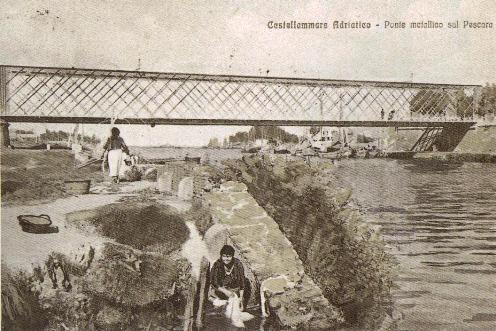
As the town grew, it attracted more workers. By the 1870s, new fishing families arrived on the north bank, coming down the coast from San Benedetto del Tronto and settling along the river. They called their neighbourhood Borgo Marina, a name that still exists today. Three families, the Spina, La Galla, and Ammirati, owned the boats, while everyone else worked for them. Boys as young as eight went to sea as “murè,” cabin boys who woke the men before dawn for fishing. They learned the trade from the bottom up, and those who made it to eighteen could become “parò,” the captains responsible for their crews. The work was tough. In a spring storm in the early 1880s, seven men from Borgo Marina drowned at the river mouth in a single morning. Fathers and sons were among them.
The third change was the arrival of quinine and drainage projects. Quinine, made from cinchona bark, became cheap and widely available in Italy in the late 1800s. It didn’t drain the marshes but helped people survive malaria. The first local drainage projects started in the early 1900s around the Pineta D’Avalos, the old pine forest south of the river. A key detail: the engineer behind the plan was Antonino Liberi, Gabriele d’Annunzio’s brother-in-law. He designed more than a public health project. He planned a “Città Giardino,” or garden city, with building lots, a beach, a stadium, a market, and a church. The town council bought the forest from the state, drained it, and sold it off in pieces. Public land became private profit, with a poet’s family behind the plan. This was the first modern Pescara strategy: take common land, improve it just enough to claim it, and turn it into real estate. By the 1920s, the marshes near town were dry enough, and quinine was reliable enough, that the population on both sides of the river grew quickly. Full drainage of the wider valley would wait for Mussolini’s bonifica integrale law of 1928 and later. The mosquitoes lost ground in stages, mostly to developers.
That same forest still exists today as the Pineta Dannunziana nature reserve, though it’s barely hanging on. Recently, it suffered two arson attacks. Where a drainage pump once turned marsh into land for building, wildfires now threaten the area. There’s a lingering suspicion, never fully proven or dismissed, that if protected parkland loses its status, it could be sold and developed. A hundred years after Liberi’s garden city plan, the way public land becomes private profit hasn’t really changed. Only the methods have.
What Mussolini Actually Did in 1927
On January 2, 1927, a single royal decree did two things at once. It merged the south-bank town of Pescara with the north-bank town of Castellammare Adriatico, creating a new city on both sides of the river. The same decree made the new city the capital of a brand-new province, the fourth in Abruzzo, formed from land taken from Chieti and Teramo. The neighbouring towns that lost territory were not happy.
A separate royal decree the following year added the inland comune of Spoltore to the new Pescara. The expanded fascist city now stretched from the river mouth back into the hill country, much bigger than any of its parts.
The official line was administrative modernisation. The 1927 reform created seventeen new provinces across Italy, including Pescara, Rieti, Frosinone, Aosta and Brindisi, each time breaking up older power bases and placing trusted prefects in charge of new units that owed their existence to Rome. Mussolini’s public language was all economic rationalisation and balanced regional development.
The private record tells a different story. The campaign had been led from 1924 onwards by Gabriele d’Annunzio, born in Pescara in 1863. D’Annunzio was Italy’s most famous and most scandalous writer of the early 20th century, a poet, novelist, and war hero who turned his celebrity into political theatre. After the First World War, he created the balcony speech, the black shirt, and the Roman salute during his fifteen-month armed fiefdom over the Adriatic city of Fiume in 1919 and 1920. Mussolini watched it all and copied the lot. D’Annunzio was the cultural figurehead the regime needed to legitimise itself before educated Italians. He repeatedly wrote to Mussolini, campaigning for his birthplace to be designated a provincial capital. The local political muscle was provided by Giacomo Acerbo, the Pescarese deputy and future Minister of Agriculture, the man whose name is attached to the 1923 Acerbo Law that engineered the fascist parliamentary takeover.
The phrase most often linked to the decision,” your Pescara,” is said in local histories to be Mussolini’s own words in a message to d’Annunzio at Gardone Riviera in late 1926, just weeks before the decree was signed. Whether or not those were his exact words, the meaning is clear. The decree used the language of administrative reform, but the real reason was to honour the poet’s birthplace.
After the Fall of Fascism
The war reached Pescara because of the railway. The Adriatic line and the junction station were strategic targets for the Allies. They were pushing north against the German Gustav Line. From 31 August 1943 to December that year, the city was bombed repeatedly. About 80% of its buildings were destroyed or damaged, and around 3,000 people were killed. The historic centre you walk through today, around Corso Manthonè and Corso Vittorio Emanuele, was largely rebuilt after the war. The city Mussolini created in 1927 was almost erased in the war his regime brought to Italy.

What came after the war was built quickly, cheaply, and without much planning. The post-war Italian building boom changed Pescara dramatically. Concrete apartment blocks were built as tall as the law allowed, and green spaces were paved over for parking. Much of Pescara, away from the beach, looks like it was rebuilt in the 1960s because it was. The city was rebuilt on the same marshy delta the Spanish once tried to control, with drainage designed for a much smaller town. When heavy rain falls, the basements still flood.
After the war, the Republic of Italy reviewed the regime’s biggest territorial changes. Spoltore became independent again on September 1, 1947, returning to its status as a separate hill town. The fascist version of Pescara was reduced to its 1927 core: the two banks of the river, the old fortress town, and Castellammare Adriatico. Today’s Pescara is more or less what the post-war republic decided it should be.
The Seam is Still Visible
If you walk through Pescara today, you can still spot signs of the old merger in the street names. Corso Umberto runs through what used to be Castellammare Adriatico, while Corso Vittorio Emanuele crosses the old Pescara side. The Ponte Risorgimento bridge now carries traffic where two separate towns once met.
Family records are split, too. If your grandparents were from Pescara before 1927, their birth records are either in Chieti’s or Teramo’s provincial archives, depending on which side of the river they lived on. People researching their ancestry often spend weeks searching the wrong archives before finding what they need.
Mussolini didn’t create Pescara. The railways and quinine did. He just put his name on the map.
The Third Pescara
What’s surprising is that the story isn’t over yet.
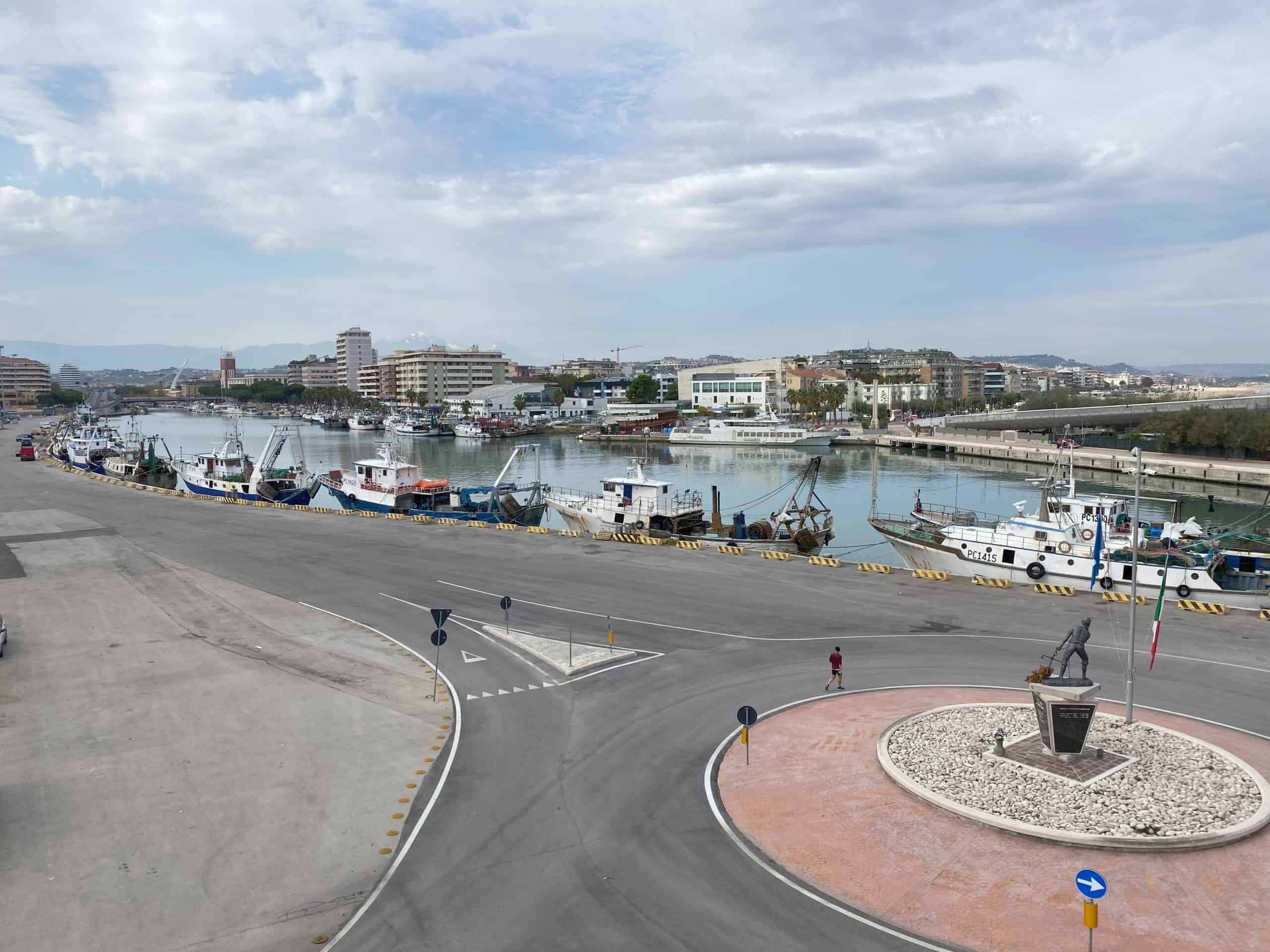
In May 2014, a regional referendum approved the merger of Pescara, Montesilvano, and Spoltore, with Pescara’s strong yes vote leading the way. In March 2023, the Abruzzo regional government passed a law making the new city official, effective January 1, 2027.
There is a bigger story behind the question voters faced. Over the past forty years, people have steadily left the inland towns of Abruzzo. Hospitals in the highland towns have been downgraded or closed, and schools have merged or shut down. The Pescara-Sulmona-Rome railway is the main line connecting the Abruzzo coast to the inland hill towns and on to the capital. It is being upgraded with €15.9 billion of national investment to bring it closer to high-speed standards by 2032. The investment improves the coastal corridor but does little to slow the depopulation of the towns above it. Young people leave the hill towns because work, services, and connections are more readily available on the coast. Older people move to the coast because the hospitals are closed. The coastal towns are growing because that is where the jobs and services are now. The merger is really just an administrative step to match a population shift that the region itself caused. Voters were asked whether to accept the results, not whether to change the reasons behind them.
Almost a hundred years after Mussolini’s decree, Pescara will be transformed again. We pick up the story in part two, where we examine the politics of the merger, the budget behind the 2027 plan, and the legal battles in Spoltore and Montesilvano.
Further Reading

Author: Sam Dunham
Sam is a freelance SEO content creator and IGCSE Geography and English teacher in Rome. She also runs the Life In Abruzzo Cultural Association, sharing stories and insights about this captivating region. Alongside raising a teenager, Sam hosts guests at her family’s traditional home, the Little House of the Firefly in Abruzzo, offering a warm welcome and insider tips on local culture, food, and hidden gems.