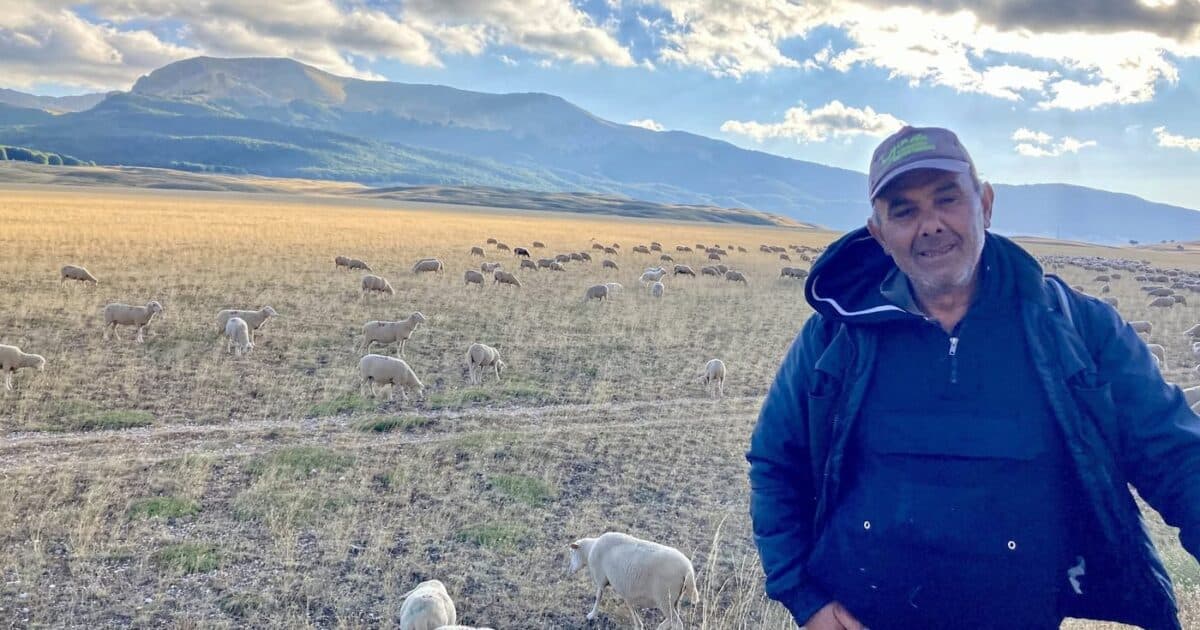
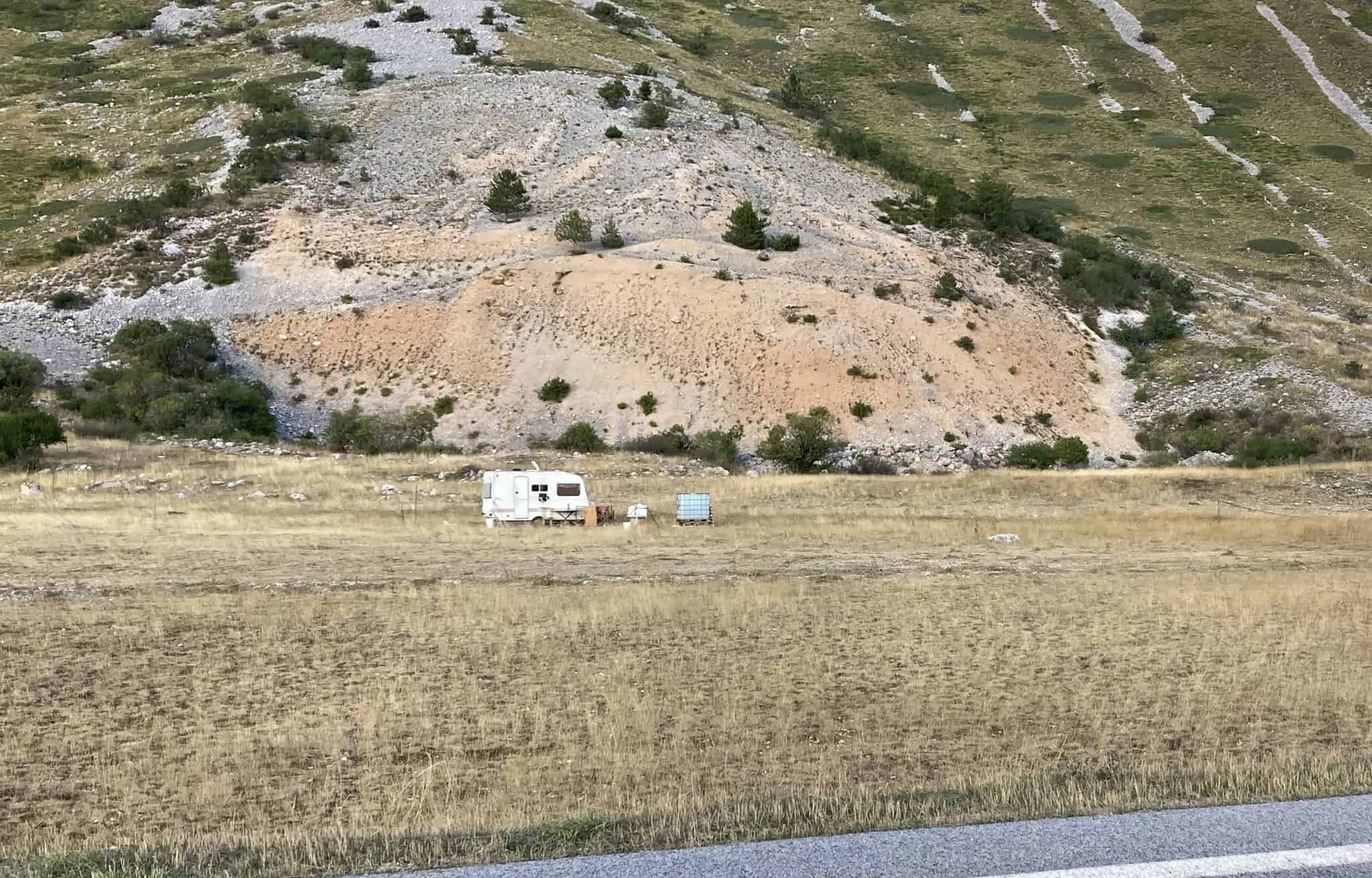
Kosovan Shepherd, Campo Imperatore © Jo Malcom
You probably didn’t come here looking for an empty village. Most people don’t. Maybe you came for a house you could afford, a stone house with a view, costing about as much as a used car back home. Or maybe you were searching for the village your family left behind, the surname from old documents, maybe still on a doorbell. Either way, once you arrived, you were likely surprised by who was here and who wasn’t.
The village isn’t as quiet as the shuttered windows might make it seem. Someone is still out there picking beans and grapes, loading trucks, milking before sunrise, and leading sheep to the high pastures. More often now, that person wasn’t born here. To really understand a place, it helps to know who keeps it going and what it costs them.
There’s a bigger story here if you look closer. Migration isn’t new in these hills, and it hasn’t happened just once. It’s like a wheel that’s been turning for generations. The Abruzzesi who left for coal mines in Pennsylvania, oil jobs in Venezuela, or farms in Argentina are one part of it. Their grandchildren, now returning and buying cheap houses, are another. Moroccans who came to work the Fucino fields are part of it too. The Bangladeshi man awaiting asylum in a mountain village is the newest addition. The wheel keeps turning, decade after decade. This piece is about the latest turn and how it’s changing the town and the people living through it.
Two Kinds of Migration
You may have read, here or elsewhere, that migrants are slowing the decline of these villages by about a third. It is true, and it is worth being clear about what it means. Rank the region’s towns by the number of foreign residents they have. Over the five years to 2024, the towns with the most foreigners lost about three and a half people in every hundred. The towns with the fewest lost more than five. So a settled foreign community does not save a village, but it does empty it about a third more slowly. In a small place, that can be the difference between the school or the shop staying open and closing for good.
Keep in mind, especially in the smallest villages, that these numbers are very small. In places with just a few hundred or even a few dozen people, one family arriving or leaving can change everything. A percentage here might only mean a few people, and in a village this size, a few people make all the difference.
You can look up any of the region’s 305 municipalities on our companion pages, People of Abruzzo and the searchable Pulse. But this slower decline comes from just one kind of migration, so it’s important to learn the difference between the two types.
One kind is settlement. Foreign families arrive, men, women and children who fill a desk in a school that was about to close. They come from many places, they stay, and sometimes they reopen a shop. That is the hopeful half of the story, and the numbers behind it are real: between 2019 and 2024, nearly 18,000 foreign residents of Abruzzo, people who had lived here long enough to build a life, became Italian citizens. Those are the ones the wheel brings to stay.
But settlement has a second face, and it is not so simple. Alongside the foreign families comes a return: about 11,000 Italians and their descendants came home from abroad during the same years, some reclaiming the passport their grandparents carried. A homecomer is not always a young family, though. Many are retirees, coming back to see out their years in the places where they or their parents were born. They are welcome, and they fill a house, but they add to the old end of a village that is already ageing, not to the school roll.
And here is the part that is rarely said aloud. The returnee and the foreign buyer beside him, the one who calls himself an expat rather than a migrant, are often the people restoring these cheap houses. That is the charm you were sold. But a house restored for a foreign pension or a diaspora nest egg is a house priced by a foreign pension, not by a local wage. The young Abruzzese family who might have stayed, raised children, and kept the school open often already has the ancestral house, handed down. But it is small and old. And when they want to move out of it into something larger, with room to raise children, they find the prices set by a foreign pension, not a local wage. They cannot. So the same money that mends a roof can close a door. And the incomer is a migrant too, whatever he calls himself, and often one who pays less tax than the teacher or pensioner next door, under a flat-tax scheme built to lure him. The wheel not only brings workers to the bottom. It brings buyers to the top, and they change a village just as surely.
The other kind of migration does not settle at all. It looks completely different: mostly young men, often of a single nationality, or a group of middle-aged people with almost no children. They are housed, but not rooted. Some are here to work, keeping the fields and the flocks going, keeping your food cheap, and caring for your elderly mother. Others are asylum seekers, placed by the state in a reception centre that a hollowed-out village happened to have room for. From the outside, the two can look nearly the same: young men, of the same origin, no children, and neither puts down roots that bring a village back. Telling them apart and knowing when either shades into something a gangmaster runs is much of what this piece is about.
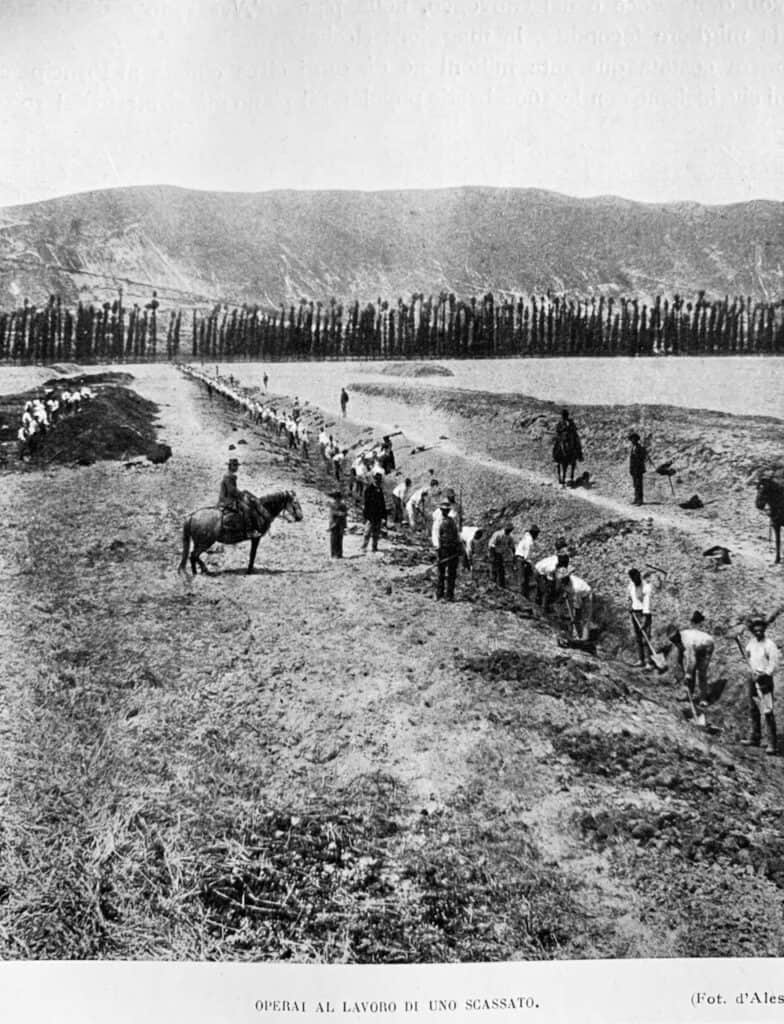
None of this is new. These mountains have always taken people in and let people go; only the names and the reasons change. When the Fucino was drained in the 1870s, families came from the Marche and the rest of Abruzzo to work the new land. For centuries, shepherds walked the great drove roads down to Puglia and home again. And for every wave that arrived, another left. The door of these hills has always swung both ways. The wheel is old. Only the newest cog, the reception centre, feels strange, and even that is just the latest way of putting a thinning place to use.
How the Harvest Gets Done
The work moves with the seasons, and the crews move with it. Grapes on the bigger wine estates in September, olives after that, and Fucino field crops for much of the year. A team can work its way around the calendar from one estate to the next, which makes the labour hard to follow. It is only fair to add the other side. The harvest comes in as a patchwork: the owner-families on the small plots, who need no outside hands; a few local pensioners and students on short legal contracts of up to forty-five days a year; and, for everything left over, the cooperative teams the bigger estates bring in. The first two cannot fill a big vendemmia. A single cooperative may pool grapes from hundreds of small growers across a whole province, a harvest many times larger than any one village could pick. The growers’ body says those teams come on proper if short contracts. This is not about estates cutting corners. It is that the people are simply no longer there. The abuse that has actually been proven in this region is over in the Fucino vegetable fields, not in the vineyards. A gang among the vines is usually the legal face of all this, which is part of why the other face is so easy to miss.
What a Caporale is
You may picture the men who prey on farm labour as a southern story: the tomato harvests of Puglia and Latina, the makeshift camps, the deaths that reach the news. It is true, and it is harsh. But it lets the rest of us believe the problem lives down there, far from the cool green hills we tell tales about. It does not. The same trade picks our pepperoncini, lifts our potatoes and minds our sheep.
The Italian word is caporale, the system is caporalato, and since 2016, it has been a crime, not a grey area. A caporale is an illegal labour broker. He stands between the worker and the boss, on a farm or a building site, and he takes his cut from the weakest person in the chain and has been here throughout the years.
And it is not only a farm word. The 2016 law covers every trade, and the same thing runs through building sites, warehouses and care work. Walk past a building site in these valleys, and the language you hear is rarely Italian. Care work hides better behind a front door. There, the worker is usually an older woman, alone in a stranger’s house, and the broker who traps her is often a woman too. We picture all this as a male world, and mostly it still is, but the care system has its gangmistresses. What changes over the years is only who stands on the bottom rung. A generation ago, it was often the Romanians and the Albanians who came with little to protect them. The Romanians moved off that rung in 2007, when their country joined the EU, and gained the right to live and work anywhere in the EU. The Albanians, whose country is still outside, moved off it the slower way, by settling, obtaining their papers, and in time becoming citizens. Either way, the hardest and least protected work was passed down to whoever was newest. The structure stays the same; only the faces change. This is never really about one nation being a problem. It is about whoever has just arrived and has the least cover.
The reporting from the Fucino, the flat vegetable plain south of here near Avezzano, shows how it works in practice. A worker who gave only the name M. told the local paper how it goes. The men are paid about 7 euros an hour, and 2 of those euros go to the caporale every hour, every day. They pay him again to be driven to the field, five euros a day, crammed into an eight-seater van. When they need a form filled out at an office, he charges for that too, up to five hundred euros for a single errand. He decides who works and who stays home, and the men who have just arrived, with no Italian and no papers of their own, cannot argue. They harvest from midnight to load five trailers before the day is out. This is not a story about one bad season. In November 2021, the finance police near Avezzano arrested three men and a local accountant for running exactly this kind of ring. A separate blitz by inspectors stopped a lorry carrying vegetables and found that more than half of the 140 workers checked were working off the books. In June 2025, after a labourer was left injured outside the hospital in Pescina with no contract and two months of unpaid wages, the prefect ordered a fresh sweep: six farms, 127 people, and 21 vans used to ferry workers, several of which were packed and uninsured.
The Man in the House, not the Shelter
Most visitors never notice this part, but it’s where the real challenge is.
When the state houses people who have fled with the aim of lifting their family out of poverty, some of it is easy to spot. The SAI projects and the family centres hold a mix: women, children, many nationalities, people waiting for a decision, and they look nothing like a workforce. But the emergency CAS, where most asylum seekers actually end up, is another matter. A CAS for adults is single men, often of one or two origins, put up in ordinary village flats and entered on the register. On paper, that is all but indistinguishable from a labour cohort. So the same shape, single men of one origin listed as residents, can be a reception centre or a farm gang. The numbers alone will not tell you which. This is the trap, and the reason you have to know whether a village has a centre before you read its men.
And that listing is a telling thing in its own right. Men working the fields or the flocks rarely end up on the village register as proper householders. When they do, someone arranges those leases, and that person is very often the same one who arranged the work. The benign version exists, and we must say so: a decent farm that houses and lists its crew properly looks the same on paper. The numbers alone cannot tell an honest employer from a gangmaster. What separates them is the wage, the hours, what is docked for the bed, and whether the papers are held over the man’s head. None of that is in any record you or I can read.
How the Moroccans got Here
It is worth pausing on the largest group of all, because their story corrects the picture most people carry. When we imagine North Africans arriving in Italy, we imagine boats and the horror of the sea. The Moroccans of the Fucino are almost the reverse of that. They are the oldest, most settled and most legal migration in this whole story.
The Fucino was a lake until it was drained in 1875, which handed the Marsica around 165 square kilometres of superb farmland. That land has needed hands ever since. Moroccans began coming for the work decades ago, in the 1980s and 1990s, long before today’s border panic. They learned the trade, were given their papers in one of Italy’s amnesties, and stayed. Then they sent for their wives and children, a legal right that has nothing to do with how tight the sea border is. That is why their villages have women, children and grandparents, where the newest arrivals have only men.
They are the backbone of the harvest now. Across Abruzzo, the Moroccans are the largest group of farm workers from outside Europe, more than 7,600 people, over 4,000 of them in the province of L’Aquila, and Luco dei Marsi has the biggest community of all. When Covid closed the air links in 2020, the farmers’ union chartered a private flight to bring 142 Moroccan workers into Pescara, purely to save the crop. Nobody slipped past anything. They were sent for because the Fucino could not be worked without them. So the next time you see Fucino potatoes proudly named on a market stall, famous across Italy, it is worth knowing whose hands made them famous.
The Moroccans work the Fucino fields. Up on the high plains, the flocks are another foreign story, and an older one. Coldiretti, Italy’s largest farmers’ union, reckons nine in ten of the region’s hired shepherds now come from outside Italy, most of them Macedonian or Romanian, with Kosovans and others among them. They keep the flocks, the milking and the pecorino going where there are no longer local sons to do it.
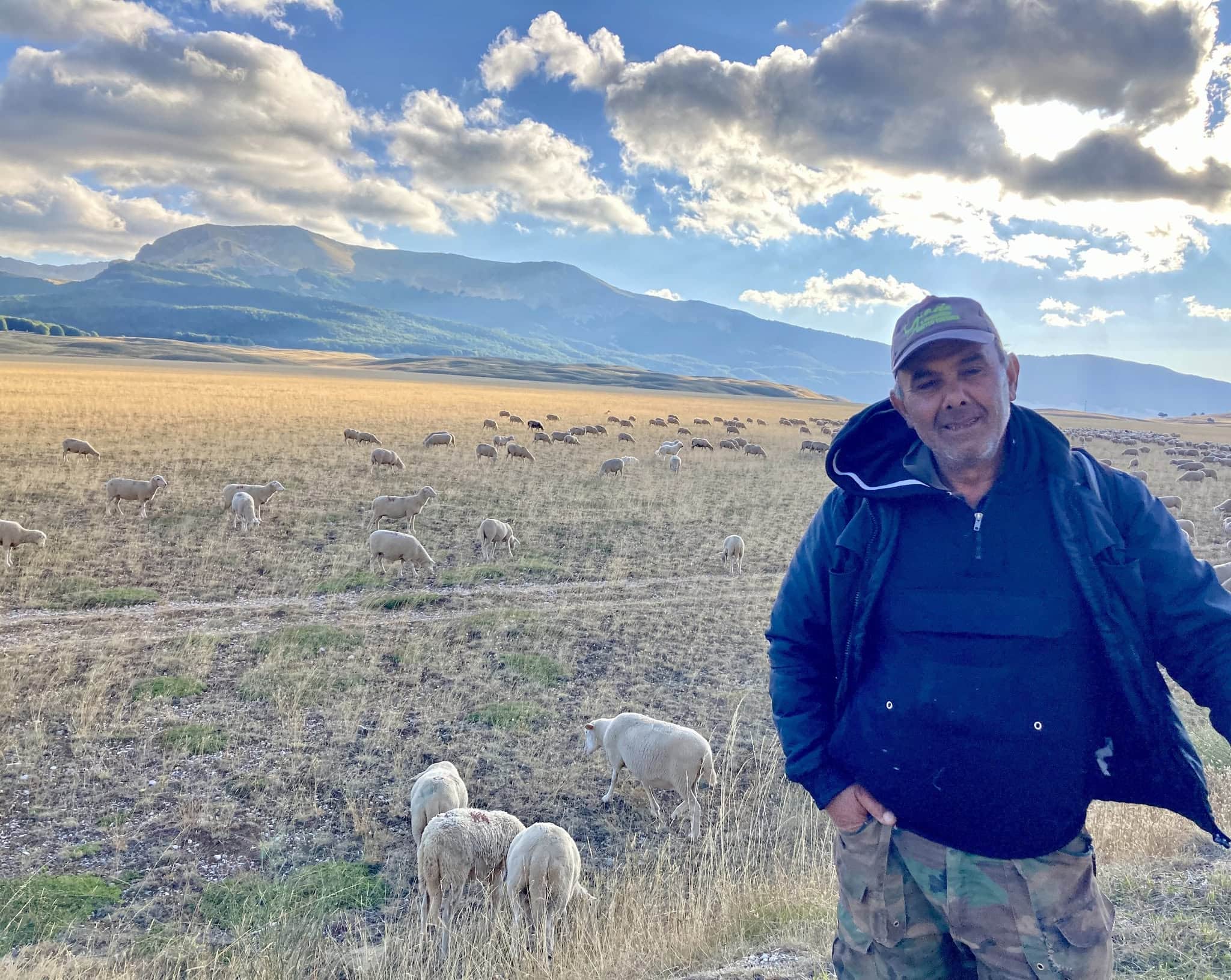
It’s a tough and lonely life. This shepherd spends two months at a time alone on the plain, with only the sheep and dogs for company, living in a caravan with a water tank.
The Asylum Road, and Where it Goes Cold
Here is the part the piece has been circling, because it is the one nobody quite finishes. What actually happens to the man in the reception centre?
Start with the rules, because they are not what most people assume. For his first sixty days in Italy, from the day he lodges his asylum claim, the law forbids him to work. After that, and this surprises people, he may. He can take a job, whether employed or self-employed, and move anywhere in Italy he likes, though not abroad. That right lasts as long as his claim is open, which can be a year, often more. He is not chained to the centre or to the fields. On paper, he is close to free.
So the wall is not a permanent ban. The wall is that the permission arrives, and he lands in a village with nothing to use it for. He may work, but there is little work here, and where a bus runs at all, it runs once a day, at an hour that meets no factory shift, least of all the night one. He may move, but with what, and to where? He came very often on a long, costly, and dangerous journey that a whole family sold or borrowed to pay for, and he came to send money home. On the reception pocket money, the daily allowance handed out in the centre, 2.50 euro a day, about 17.50 euro a week, he can send home nothing at all. The pressure to find cash, any cash, is not a weakness in these men. It is the entire reason they are here.
In a city, there is at least an answer, of a grim kind, and he does not have to reach Rome to find it. Pescara and Vasto on our own coast have the same informal economy waiting, and Rome, the next real metropolis, more of it again: a kitchen to wash up in, a delivery bag, a market stall, the hand car wash on the ring road. That last one you have used yourself. Five men appear the moment you pull in and have the car gleaming in ten minutes for twenty euros, and it is worth wondering, next time, how little of that twenty reaches the man with the sponge, and who takes the rest. It is low pay and long hours, mostly off the books, a night in a crowded flat with eight other men and a mattress by the hour. It is exploitation of its own kind. But it is money, and money can be sent home. That is the escape the coast and the city offer, and the mountain village does not.
The mountain village offers no such hatch. There is no restaurant needing a dishwasher, no warehouse, no round to deliver. So a man who may legally work, and desperately needs to, and has nothing near him to do it at, is left with three roads. He can sit in the centre on that pocket money and send nothing, and slowly come apart. He can take the informal day-work that does exist within reach, in the Fucino fields an hour south, on exactly the terms M. described, because a broker asks no questions his papers cannot answer. Or he can leave, for the coast or for Rome, and take his chances in a kitchen or on a car-wash forecourt.
And this is where honesty runs out, for us as much as for him. Once he leaves that village, we lose sight of him. Registered or not, with or without a permit, he steps off the edge of every list we can follow. Does he become a legal labourer somewhere, on a real contract? Does he end up in a Roman kitchen for four euros an hour? If so, where does he sleep, and who is taking a cut? We cannot tell you, because the system cannot tell you. A reception centre can say how many men it holds tonight. It cannot be said what became of the man who left last spring. And that gap, the not-knowing, is not a footnote to the danger. It is the danger. A caporale does not need to break into a locked system. He lives in the gap where nobody is looking, a registered man with a temporary permit, a family in debt, and 17.50 euros a week, who walks straight into it of his own accord because every other door is shut.
How to Read a Village
Two villages in the same province show you how to look. They carry a similar headline figure. Underneath, they are opposites. Once you can tell them apart, you can read any comune on the list.
Take Ofena first, up near the Gran Sasso, where one resident in four is a foreign national, the highest share in the province. Of its 111 foreign residents, 48 are Bangladeshi men, and not one is a Bangladeshi woman. One nationality, no women, single men in a village with almost no work but the land: it is the shape that elsewhere has turned out to be organised farm labour, and it would be easy, and wrong, to leap to it.
Because Ofena has something the numbers alone do not show: a reception centre. A CAS, for asylum seekers, sits in the village with room for 44 adults, and 44 against 48 is no coincidence. Those men are almost certainly not a farm gang but people waiting on an asylum claim, housed there by the state and registered as residents, which is the only reason they appear in the count at all. Everything the last section described, the sixty days, the 17.50 a week, the roads out, is their daily life, in this village, now.
Now look at Anversa degli Abruzzi, a borgo half an hour south. It too is heavily foreign, with about one resident in six. But its 52 foreign residents are another thing entirely. Just over half are Romanian, and the rest are a scatter of nationalities. The sexes are even, 24 men to 28 women. There are small children at the foot of the age chart and women in their seventies at the top. Romanian families work on the dairy and sheep farms here, and as EU citizens, they need no permit or employer’s signature to stay. This is settlement: families earning a living and putting down roots. It is the village doing it right, and there is a quiet continuity to it, since the folds and the milking have been Abruzzese work for centuries. The Romanian families took up the pails. The job stayed; the hands changed.
So here is the lens: four things to look at.
- The men and the women. A balance means families. All men means a workforce, or a reception centre, or the grey traffic between; the one shape the numbers cannot read alone, so for an all-male village, check first whether it has a centre.
- The nationalities. Many grown over time means a community. One young male nationality refers to a group brought together by a gangmaster or by the state.
The children and the old. The surest sign that people mean to stay. - Who is free? A Romanian, or any EU citizen, can walk away from a bad boss. A man whose permit is pinned to one employer, an asylum seeker on 2.50 euro a day, or a man with no papers, cannot.
The shape tells you the question, not the answer. Even a settled village can hold hard, underpaid work, and even a troubling one may be wholly legal. It is where you start looking, not where you stop.
Why Here?
You may wonder why a centre lands in a place like Ofena at all. There isn’t much there, and you are right. But nothing is an accident of the placement. Not much is the reason for it.
It begins with the buildings. Reception is run by the prefecture on a fixed per-person-per-day basis, and the contract to run it is largely won on price. A cooperative that must put up forty beds cheaply goes looking for empty property, and a thinning mountain village is where empty property is nearly free: the shuttered small hotel, the half-used convent, the flats left behind by the dead and the departed. The very emptiness that is thinning Ofena is what made it cheap enough to fill.
Then the quiet, and this too is a decision, not an accident. Someone chooses to scatter asylum seekers thinly across the smallest inland comuni, rather than house them where the work and the buses are, and the reason has nothing to do with the men. It is that a village of four hundred cannot raise the protest a town of forty thousand can. Spread people thinly into weak, quiet places, just like Mussolini did with his internment camps in Abruzzo and the political noise stays low. And the comune barely gets a vote: a CAS is imposed by the prefecture, the state’s own local arm, over the heads of the people who live there. A thinning village will often take it even so, because it is offered nothing else. Sometimes the centre is the only economy left, a state contract, a few local jobs, rent for someone’s empty building, so the mayor who might have objected cannot afford to.
And warehousing pays. Where there is a guaranteed sum for a guaranteed body, operators appear who are in it for the sum. Most of Abruzzo’s reception is run by serious bodies, ARCI, Caritas, the dioceses, social cooperatives that also care for the old and the disabled, and it would be wrong to tar them. But the model itself, paid by the head, won by the cheapest bid, watched by almost no one, has been captured outright elsewhere in Italy. There was the Rome trial, where migrants were recorded as more profitable than drugs. The Calabrian centre, where millions meant for the housed simply vanished. The pocket money that was never reached the men it was owed. None of that has been shown in Ofena. But the structure that allowed it is the one running quietly in these hills, and a system built on cost and silence is not one to be taken on trust.
Whose Emptiness is it?
You’ll often hear people in these hills, and in the comments under articles like this, say that migrants are the problem, that there are too many, and that’s why the village feels different. But this view has it backwards, and it’s important to explain why.
The village did not empty because migrants came. The migrants came because the village emptied. And the village emptied for reasons unrelated to anyone arriving. It emptied because there is no work that a young person can build a life on, because Italy has poured its attention and its money into the cities and the north for 70 years, because a mayor of a mountain comune can attract a factory, if he is lucky, and little else, so the young who want anything other than a factory leave. Depopulation is not something outsiders did to these villages. It is something Italy allowed to happen to its own interior, quietly, for decades.
And once a place is that hollow and that poor, housing migrants for a state fee is simply the only card left to play. Who could blame a comune of four hundred people, with a closing school and a shrinking budget, for taking the one contract on offer? It is not welcome, exactly, and it is not always kind, but it is survival, and survival is what these places have been reduced to.
The migrant, meanwhile, is not the cause of any of this. He is fleeing his own version of it. The same grinding poverty, the same absence of work, the same sense that everything worth having is somewhere else, that drove eight and a half thousand young Abruzzesi out of this region in a little over a decade, is what put a Bangladeshi man on a boat. His village and this one are not opposites. They are cousins. He left a place being hollowed out by forces far above him, and he arrived in one being hollowed out by forces far above it, and the cruelty is that the two are set against each other as if either had a choice. Neither did. The teacher who left for Bologna and the man who left Dhaka are running from the same thing, and neither of them broke the village. The village was broken long before by people who never had to live in it.
The Loop, and the Way Out
There is a sad mechanism under all of this, and it is worth saying plainly. A village empties. The houses go cheap, the average age climbs, and the people left are too few and too old to work the land or to ask many questions. And the land still needs working, the eggs still need picking, the sheep still need minding. So the quiet, empty, unwatched village becomes useful precisely because it is quiet, empty and unwatched. Whether it is a labour crew housed in a spare farmhouse or a reception centre in a former convent, the decline is not reversed. It is repurposed.
And this is not a poor country. The fields around these small villages are farmed by serious producers, some of them names you would know from a supermarket shelf. When the people who pick and herd are paid little and housed badly, it is not because the money is not there. The money is plainly there. It is a question of where it is allowed to go, and of how little of it stays in the village whose land is being worked.
But it is not fixed, and the piece should not pretend otherwise. Anversa shows the other road: families with the freedom to put down roots and the continuity that follows. What decides whether a village stays a reservoir, a labourer or an asylum, or becomes a living place again, is not fate. It is whether people are allowed to build a life: a legal status not chained to one boss, the right to bring a family, a wage you can question without losing your job, and a village with something in it worth staying for. The loop is real, but it is a choice the country keeps making, not a sentence it has passed. And naming it is the one thing the loop cannot survive, because it runs on nobody looking.
Saffron for Shoes
There is one more thing that should stop any reader feeling distant from this, and it is the closest to home of all. Within living memory, the people doing this work were the Abruzzesi themselves.
On our own pages, a member shared his story of growing up in Castelnuovo, the hamlet beside San Pio delle Camere, in the middle of the Navelli plain, the very ground we have been walking. He remembers the saffron harvest as a boy. In late October, the family would walk to their fields in the hills at dawn, to pick the flowers as the sun came up, the women singing old Abruzzese songs as they worked. At night, they would separate the crimson stigmas from the yellow. His reward was a new pair of shoes and a little carving knife, bought by his mother at the San Silvestro market in L’Aquila. “What happy times those were,” he writes.
That is the same cold, crouched, before-dawn work that migrant hands do on that plain today. The labour has not changed. What has changed is that his family did it for themselves, for their own shoes, and walked home together, while the men who took it on after them are working someone else’s land for a wage a broker has already shaved. And it was not only the men’s work that changed hands. It was Abruzzese women who once bent in these fields at dawn and held the households together, the women singing in the saffron rows, the daughters minding the old. They have since moved on to other work or left the region altogether, and their labour has passed into migrant hands too: the men in the fields and the foreign women, the badanti, now caring in the same houses for the same elderly parents that a local daughter once would have. The village that taught a boy to pick saffron is now the one that houses the strangers who pick it. They did not take his place. He left it, and the work still had to be done.
The Figures, and who Reads Them
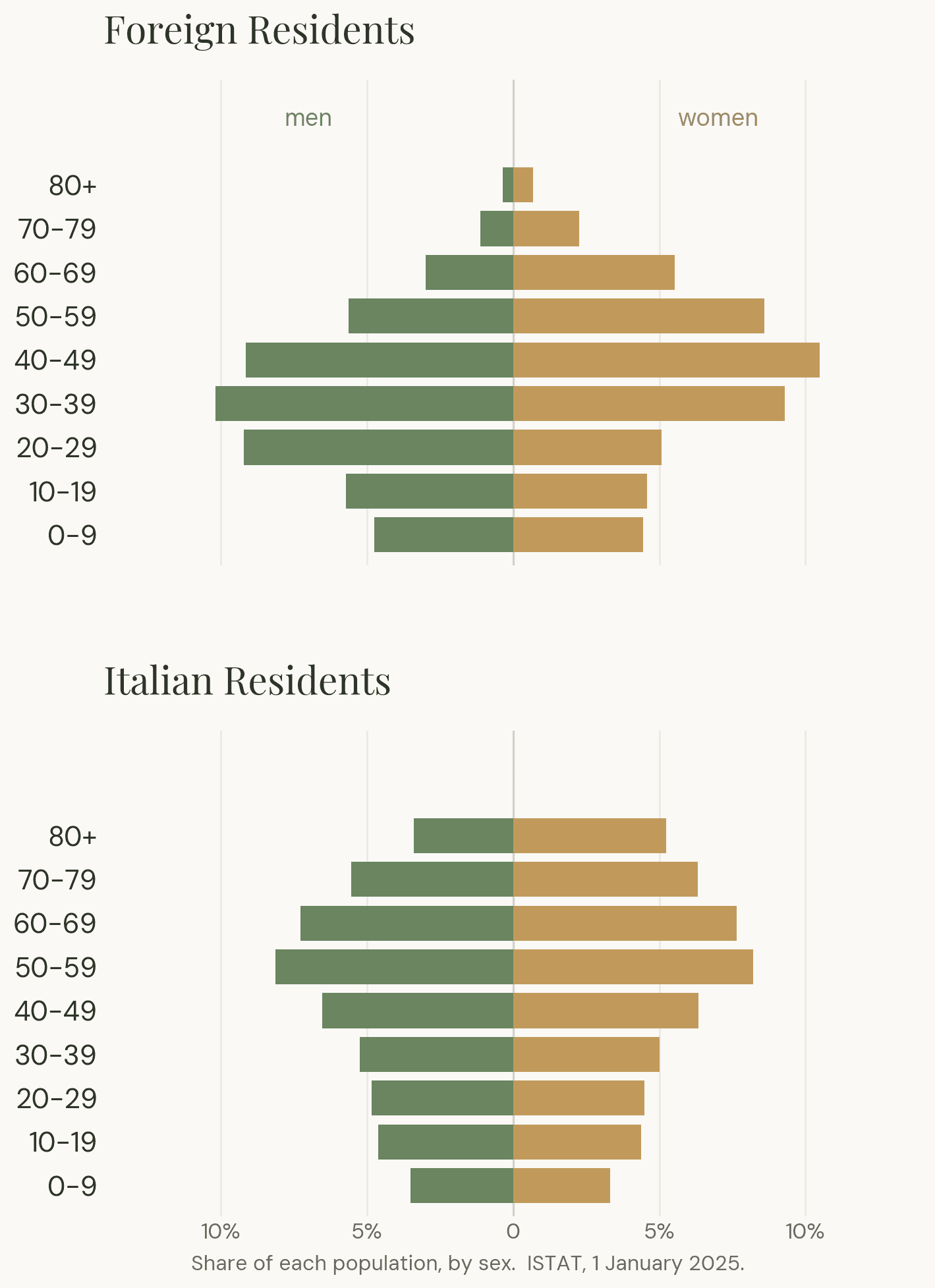
Abruzzo’s residents by age: foreign-born vs Italian. The foreign shape bulges through the working years, men and women both, exactly where the Italian shape is hollow. These are the people picking, herding and caring, present in the very decades the villages have lost. You can read the full figures, town by town, in People of Abruzzo and the coming-soon searchable Pulse.
Put the two pyramids side by side, and the whole argument sits in one picture. Sixty-eight in every hundred foreign residents are of working age, twenty to fifty-nine, against forty-nine in a hundred of the locals. Just four in a hundred are over seventy, against one local in five. The foreign population is not a scattering of strangers. It is a working-age generation dropped precisely into the gap the village’s own young left behind.
But a pyramid shows working age, not the work. For that, you have to ask what the two sexes are doing, and here the region has handed us a lesson in how a true figure can mislead. The region is proud, just now, of a rise of around 5.5% in the number of women working in Abruzzo, one of the strongest in Italy. It is held up as a sign of a region on the mend. It is not untrue. But it is the figure the region chose, and it does not sit easily beside ISTAT’s own. The 5.5% is measured from the depths of the pandemic, a multi-year rebound, not fresh ground won. Set against it, ISTAT’s latest annual numbers show the female line has already stalled, even slipped, while that year’s growth went to men, in construction. The two official sources do not tell the same story, and the region has understandably reached for the one that flatters.
Read it up close, and it loosens further. What growth there was fell to older women, an ageing of the workforce rather than a fresh start for its daughters. And it fell into the lowest-paid work, the sectors ISTAT files under: construction, tourism, and personal services. Servizi alla persona, personal services, is the polite name for cleaning and caring, the badante economy. Much of “more women working” is more women in paid care. And female participation in Abruzzo is still below the national average, so this is a rebound in the poorest work, already out of the road, sold as a fresh start. Check out our figures for the Fucino plain in detail, more than 38% of families live on one income.
Our own figures say how many of those women are. Abruzzo’s foreign population is now female-majority, about 46,000 women to 44,000 men, which is the shape of care, not of the fields. Nearly half of them, more than 21,000, come from the handful of countries that supply Italy’s carers: Romania above all, then Ukraine, Poland, Russia, Bulgaria. When one of them is at last given a contract to mind an old man in a hill town, she becomes, in the statistics, a woman who works, counted rightly as a success. What the number cannot say is that she is often doing the exact work an Abruzzese daughter once did, in the house of parents whose own daughter has gone to Bologna, or abroad. The figure rises. The village knows why, and it is not the reason in the press release. We cannot give you the precise share that is migrant because the regional employment figures are not finely enough disaggregated by nationality to show it, and we will not pretend to a number we do not have. But the direction is not in doubt.
And that points at something larger than any one statistic. A region can be told, in good faith and by real figures, that it is doing well, while every one of its villages knows something those figures do not say. Gather the mayors, shopkeepers, and schoolteachers of three hundred emptying comuni into one room, and read them the topline. They would nod at the arithmetic, then quietly tell you what is under it: the daughter gone, the foreign carer arrived, the class of six, the old house sold to a stranger for a song. They already agree with the analysis on these pages, because they live it. What is missing is not the data; Italy counts itself carefully. What is missing is the interrogation of it, the willingness to ask what a good number is actually made of, and the conversation between the places that live the answer. One village is easy to wave away as a sad exception. Three hundred saying the same thing is a pattern, and a pattern is harder to paper over.
Why Does this Belong in a Travel Story?
Because the same empty, cheap houses you are dreaming of, the ones the one-euro schemes cannot fill, are in some villages being quietly filled instead by men working, or waiting to work, on someone else’s land. The union that defends them puts it plainly: these workers grow a large share of the region’s food, and they keep villages of six or seven hundred people from emptying altogether. The Italian bishops have praised migrant shepherds for keeping the inner hills alive. Both things are true at once. The same man can be wronged over his wages and his roof, and also be the reason the cheese, the saffron, and the carrots still exist.
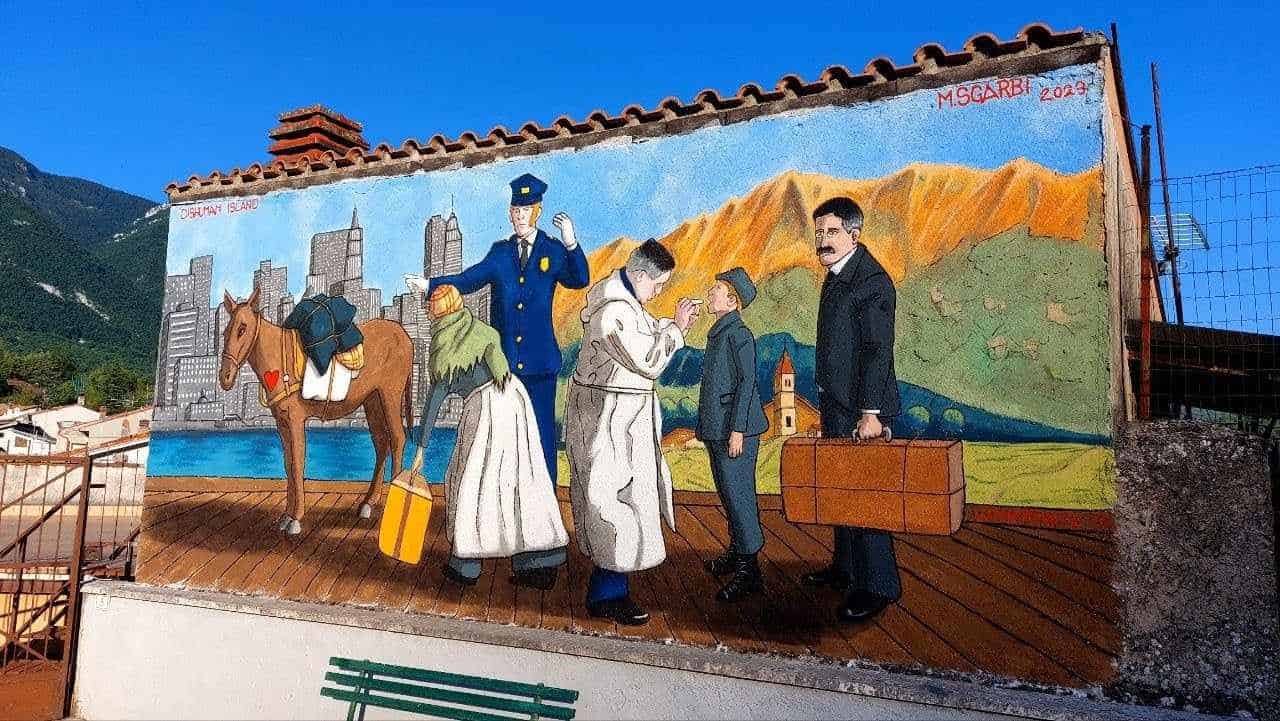
A man who cannot stay, cannot work where he is, and cannot go home has three roads, and none is good. He can take the cash work the Fucino offers an hour south, on the caporale’s terms, because a broker asks no questions his papers cannot answer. He can make for a city, Pescara or Rome, and wash dishes for a pittance, eight to a room. Or he can push on past Italy altogether, north to Germany or Britain, where the money is several times better, and there are others from home, even though there is no legal way to get there and the crossing is dangerous and, at the far end, unwelcome. That last road is illegal, and it is worth being honest about it. But a century ago, Abruzzo’s own sons did the same sum and got on boats, and the only difference is that the doors were then open to them, the coal towns of Pennsylvania, the farms of Argentina, and to him they are shut despite people like him holding up Italy’s famous agriculture sector. The desperation is identical. The gate is not.
None of this should stop you from loving Abruzzo. It should just keep your love clear-eyed. When you buy eggs at the Saturday market or watch a flock cross the old drove road and reach for your camera, take a moment to think about the person at the other end, the latest in a long line of people who have come and gone from these hills. And here’s an honest truth: once someone moves on from the quiet village where the state placed him, whether to a field, a city kitchen, or somewhere we can’t name, we lose track of him completely. A place that can’t say where its people went is open to the worst kinds of arrangements. Before you fall for the view, at least notice who is standing in it, and remember to keep looking, even after they’ve gone.
Sources
- Caporalato sweep in the Fucino, June 2025 (six farms, 127 people, 21 transport vans): ANSA, Rete8, Info Media News.
- The injured worker left at Pescina hospital; the trigger for the 2025 operation; Flai Cgil response and the “Carovana dei diritti” at San Benedetto dei Marsi: News Town, Abruzzo Sera. National comparison: the death of Satnam Singh in the Agro Pontino, 2024.
- Worker testimony on the caporale’s cut, transport charge and paperwork fees: Il Centro.
- November 2021 finance police operation (three men and a local accountant arrested); the “Alt Caporalato” inspection (11 farms irregular, 92 labourers off the books); the inspectors’ blitz (140 workers, 16 farms, 61 irregular): Il Centro, MarsicaLive.
- Roughly 60,900 irregular workers in Abruzzo: CGIA, via AbruzzoWeb.
- Nine in ten of Abruzzo’s salaried shepherds are Macedonian or Romanian, the Macedonians the earlier wave and Romanians now the larger; informal pay around 1,000 euros a month: Coldiretti and Caritas-Migrantes via Vita.it, and the TRAMed study by Michele Nori, European University Institute, via Il Fatto Alimentare.
- Hardship and voluntary aid on Campo Imperatore (Abruzzo Crocevia): laquilablog, December 2024. Praise for migrant shepherds reviving inner areas: Italian Bishops’ Conference, via Vatican News.
- Legal entry quotas (Decreto Flussi 2026 to 2028, DPCM 2 October 2025; 88,000 seasonal places, about 40,000 agricultural in the first January allocation): Ministero del Lavoro; Prefettura di Macerata.
- Ofena population and nationality breakdown (111 foreign residents, 25.2% of the village; among those foreign residents, 48 Bangladeshi (all men, not one a woman), 17 Romanian (7 men to 10 women), 10 North Macedonian and a long tail; the foreign residents split 77 men to 34 women): ISTAT, popolazione residente per cittadinanza, 1 January 2025.
- Anversa degli Abruzzi nationality breakdown (52 foreign residents, 17.3%; 28 Romanian, 53.8%; 24 men to 28 women; children and elderly present): ISTAT figures via Tuttitalia.
- Gioia dei Marsi nationality breakdown (275 foreign residents, 16.3%; Moroccan 181, 65.8%, 110 men to 71 women; Pakistani 53; 163 men to 112 women overall; children present): ISTAT figures via Tuttitalia.
- Moroccan community in the Marsica, the largest in Abruzzo, rooted over decades and central to the Avezzano potato harvest; Luco dei Marsi, the biggest community: Virgilio, Abruzzo Sera. Scale (over 7,600 Moroccan farm workers in Abruzzo, more than 4,200 in L’Aquila province): Coldiretti Abruzzo on ISTAT 2019 figures, via AbruzzoWeb and Terre Marsicane. The 2020 “salva Fucino” charter flight of 142 Moroccan workers into Pescara: AbruzzoWeb, Terre Marsicane (as above).
- The draining of the Fucino in 1875 (around 165 square kilometres of farmland); the Torlonia estate and post-war land reform: Treccani. The Marsica peasant world of Ignazio Silone’s Fontamara.
- Caporalato as a criminal offence: Law 199 of 2016, article 603-bis of the penal code.
- Care-sector caporalato and its different, mostly female shape (a woman recruiting carers online and placing them in private homes, no rest, wages below contract, families defrauded too): August 2024 Bologna carabinieri operation across Emilia-Romagna and Tuscany, via Vita.It, Bologna Today and Il Resto del Carlino. These care cases are documented outside Abruzzo; in the piece, the sector is named generally, not as a proven local ring.
- Grape harvest labour on the larger Abruzzo wine estates (most wine made by owner-farmers; the bigger estates use cooperative harvest teams on fixed-term contracts; documented exploitation concentrated in the Fucino vegetable country, not the vineyards): Consorzio Tutela Vini d’Abruzzo and Coldiretti, via Virtù Quotidiane; Flai Cgil.
- The simplified occasional farm-work scheme letting pensioners and students do up to forty-five days of seasonal work a year, such as the grape harvest, on contract with pension and accident cover, with pensioners admitted even after recent farm work, and made permanent from 2026: Law 197 of 2022 and Law 199 of 2025; INPS Circular 102 of 2023; Ministero del Lavoro.
- Homecomers and new citizens (about 11,000 people returned from abroad, and nearly 18,000 naturalised, 2019 to 2024): ISTAT, via the Life in Abruzzo residents data.
- Americans leaving in record numbers (an estimated 180,000 in 2025): Global Citizen Solutions. Abruzzo’s 7% pensioners, 88 in 2021 rising to 221 by 2024, and the United Kingdom and United States as the two largest sources: Ministry of Economy replies to parliamentary questions.

Alongside raising a teenager, Sam hosts guests at her family’s traditional home, the Little House of the Firefly in Abruzzo, offering a warm welcome and insider tips on local culture, food, and hidden gems.

Author: Sam Dunham
Sam is a freelance SEO content creator and IGCSE Geography and English teacher in Rome. She also runs the Life In Abruzzo Cultural Association, sharing stories and insights about this captivating region. Alongside raising a teenager, Sam hosts guests at her family’s traditional home, the Little House of the Firefly in Abruzzo, offering a warm welcome and insider tips on local culture, food, and hidden gems.