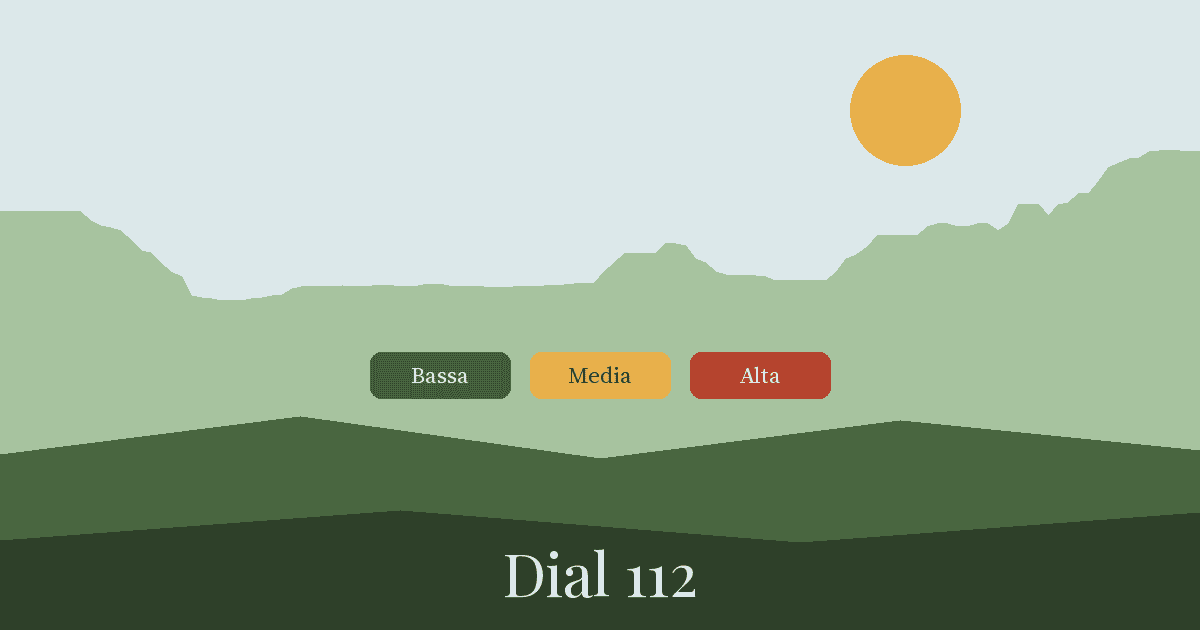
If you spot a wildfire, call 112 immediately. Read the rest of this guide after you’ve made the call.
What Number Do I Call?
112 is the only number you need. Save it as a contact in your phone now, and ask everyone in your household to do the same. In an emergency, you’ll remember a name, not a number.
112 is the European emergency number and works everywhere in Italy, any time, from any phone. In Abruzzo, all old emergency numbers connect to the same centre, so you don’t need to decide whether it’s fire, police, or ambulance. Call 112, and they’ll send the right help.
- They speak your language, English and thirteen others. This is more helpful than any phrasebook, because when people are scared, they often forget their second language.
- An Italian speaker will answer first. Say “English” clearly and wait. They will bring an interpreter onto the call. Don’t hang up if there’s a short wait; you haven’t done anything wrong.
- Don’t assume someone else has called. Make the call yourself.
What Do I Say When I Call?
You don’t need to speak Italian; just give information. If you have these four things ready, the call will take only about 30 seconds.
- Say where you are: give the comune and province, not just the small hamlet. For example, people in L’Aquila may not know Bascianella, but everyone knows Colledara. If you’re on a road, the road number and kilometre marker are very helpful.
- What is burning? Woodland, scrub, a field, a building.
- Which way is the wind pushing it, and are there houses that way?
- Whether anyone is in danger, and whether anyone is already there fighting it.
How Do I Tell Them Where I Am?
Finding your exact location can be tricky out here, but your phone can help more than you might expect.
- Your phone might already be sending your location. Phones sold in Europe in recent years automatically share your position with emergency services when you call. Italy has activated this feature region by region, so they may have your exact spot or just an estimate from the nearest cell tower, which can be far off in the mountains. Always tell them where you are, just in case.
- Install the free official 112 app called “Where Are U,” as recommended in Abruzzo. It calls 112 and sends your location, and it lets you make silent calls or send texts if you can’t speak. Still, don’t rely on the app alone; almost everyone still calls directly.
- If they ask for your coordinates, Google Maps can provide them. Press and hold your location on the map, then read the numbers out slowly. Numbers are easier to understand than place names across languages.
- Use WhatsApp to share your live location with neighbours or someone from the comune. You can’t send it to 112, but it’s easy to share with others in just a couple of taps.
What If the Fire Takes the Power and Signal?
Plan for the power and signal to go out. This is the situation you should expect, not a rare event.
Fires usually take down power lines first. Mobile towers then run on backup batteries, which last only a few hours, so your signal will fade later, often at the worst time. Landlines aren’t reliable either, since most rely on the internet and need electricity. The village WhatsApp group will also go silent first because it needs data.
- Check which mobile network works at your house, not just in the village centre.
- Keep a power bank charged and a phone charger in your car. Your car doesn’t rely on the power grid.
- If you have an iPhone 14 or newer, you can reach 112 by satellite in Italy since 2023. Dial 112 as usual; if the call doesn’t go through, your phone will offer to send it via satellite and show you where to point it. You’ll need open sky. Some newer Android phones can do this too, but check if it works in your area.
- Look for this feature in your phone settings tonight. Apple offers a demo mode so you can practice without making a real call. Spend ten minutes learning it now, so you’re ready if there’s ever a fire.
- Stay in your village WhatsApp group, but don’t rely on it for warnings. The real warning is someone knocking on your door, and that only happens if they know you live there.
What Do I Do if I’m Caught Outside?
This advice might not come naturally, so learn it now before you need it. The official guidance from the Protezione Civile is clear:
- Get out towards a road or a watercourse, never in the direction the wind is pushing the fire, or you can be trapped with no way through.
- If you cannot outrun it, lie flat on the ground with nothing burnable on it. Smoke rises; staying low keeps you under it.
- If there’s truly no other option, cross the fire where it’s thinnest and move onto ground that has already burned. This might sound strange, but burnt ground won’t burn again.
What Do I Do if the Fire Is Near the House?
Ring 112 first. Then, in this order:
- Close the windows and shutters. Embers get in through gaps long before flames arrive.
- Shut off the gas at the bottle or the meter.
- Pull anything that burns away from the walls. Wood stacks, plastic furniture, the fuel can in the shed, the parasol.
- Wet down what you can reach from the ground. Do not get on the roof with a hosepipe.
- Put the go-bag by the door: documents, medicines, chargers, glasses, the dog lead, a change of clothes.
- Park facing out, keys in your pocket, not on the hook.
- Fill the bath and the sinks while you can. If the power goes out, the pump goes out.
Then listen. The order to leave comes from the mayor, and the word is evacuazione. If you are told to go, go.
What About My Animals, Chickens and Hives?
This advice is for people with a few animals, not those who farm for a living. Local farmers know what to do, but many of us moved here with a dog, picked up some hens, or got a beehive without planning for emergencies. Make your decisions early in the year, not at the last minute.
- Dogs and cats hide when they’re scared, often better than you can find them. Put them in the car or a carrier early, even if it feels unnecessary. If you wait too long, your cat might already be hiding somewhere you can’t reach.
- You can catch chickens at night, but not during the day. At night, you can easily lift a hen off her perch, but during the day it’s much harder and takes longer. If there’s a risk and it’s getting dark, put them in a box then.
- If you can’t take your hens, don’t leave them locked in. They’ll try to return home, but a coop is just a wooden box full of straw. Leave it open. A loose hen has a chance; a locked one does not. The same goes for any animal in a wooden shed.
- Beehives are often lost in fires, and that’s the reality. Bees can only be moved at night, when they’re all inside, and you rarely get enough warning. So prepare in advance: clear the area around your hives, keep them away from thick brush, and make sure you have vehicle access in case you need to move them quickly.
Will They Save My House?
No, if they have to choose, they will let a house burn.
This is not improvised on the night. A comune’s emergency plan exists, in its own words, to safeguard human life first and property second, and the national fire-campaign guidance says the same. The order is people, then buildings, then trees. Not because a house does not matter, but because a house can be rebuilt and you cannot.
Would they let the whole village burn? In reality, no—and the reason is practical, not heroic. Villages are where people live and are easier to defend, with wider roads, water, and barriers like walls and pavement. An isolated house isn’t ignored out of neglect; it’s just last in line when resources are stretched. You can’t change your priority during an emergency, but you can improve your chances in advance by clearing brush, keeping access roads open, and ensuring there’s water for firefighters.
If you’re told to leave, do so. Some people think they should defend their homes, like in Australia, but that’s not expected here. The best way to help emergency crews is to make sure they don’t have to come back for you.
Who Is Actually in Charge?
Not a local fire brigade. There isn’t a local fire brigade. The Italian fire service, Vigili del Fuoco, is a national organisation. Each province has one main command centre and a few small outposts, so your nearest crew might be far away and already busy. That’s why the wait can be long, and waiting is often the hardest part. Each comune has a Referente Operativo Comunale (ROC), who is the council’s main contact for emergencies. The mayor is in charge of civil protection and gives evacuation orders, but can’t be everywhere at once. The ROC keeps the emergency plan up to date, manages contacts, and coordinates evacuations. In small towns, he often leads the volunteer group, too. It’s a lot of responsibility for little pay. In a comune with several villages, the ROC cannot be everywhere, so each village often has its own point of contact, the person who hears first and knocks on doors. He knows which houses have an elderly person in them and which tracks a tanker cannot climb, and he is the one who knocks and tells you it is time to go.
- Find out both of these people’s names and phone numbers in winter, and save them in your phone alongside 112.
- Ask the comune for its emergency plan (the piano di emergenza comunale), which names the assembly points, and find out which building is your gathering place if you are told to leave (the area di attesa).
- Ask where the local volunteer group meets and consider joining; they always need more people.
The regional operations room is staffed jointly by the fire service, the Carabinieri Forestali, who police the forests, regional staff, and volunteers. The water-bombing aircraft are dispatched nationwide when the regional teams cannot contain a fire on their own. Your man cannot conjure a plane. What he can do is tell you when to be in the car, which at two in the morning is worth more than you think.
If you’re in the process of choosing a house instead of already living in one, pay close attention to water supply, access roads, and the slope of the land. There’s a separate guide on what to check before buying a rural house in Abruzzo.
How Do I Know the Fire Risk on a Given Day?
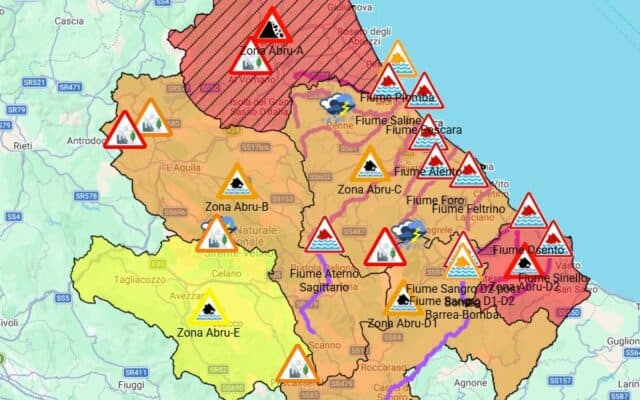
Check the published risk level, not the temperature. Abruzzo issues one for your province every single day, at allarmeteo.regione.abruzzo.it, and pages like Meteo in Abruzzo repeat it when things get tense. It has three settings, and they are not vague:
- Bassa. A fire could be handled with ordinary means.
- Media. A fire would need a fast, efficient response from the whole firefighting system.
- Alta. A fire would almost certainly require water-bombing by helicopter or a Canadair plane.
Alta does not mean be careful. It means that if something catches fire today, they will send Canadair. That is the day not to run the strimmer over stones, not to burn anything, not to park on dry grass, and to know where your documents are. It covers the next 24 hours with a tendency for 48, and it is provincial, so it cannot tell you about your own hillside, only what kind of day it is. In August, that is worth thirty seconds over coffee.
And what about the temperature? Try not to focus on it too much. Many people check it constantly in summer, but it doesn’t tell the whole story. The risk level depends on heat, vegetation, land use, and the shape of the land. The thermometer is just one factor, the risk level is what really matters.
When Is It Safe to Burn My Own Prunings?
Earlier in the year than you think, and by a stricter rule than the law’s. The ordinance bans burning from 22 June. But look at the meadows in May: that is hay, standing dry for weeks before anyone cuts it in early June, and it takes a spark like paper, the same for wheat drying in July, ready for cutting in early August. The land does not wait for a date, and everything you do in that gap is perfectly legal. That is the gap where it goes wrong.
So don’t just follow the legal minimum. Our rule is simpler: don’t burn anything after April. If you still have prunings in May, wait until winter, let them rot, or chip them. Before lighting anything, ask yourself honestly: if this got out of control in the next minute, what would I do? Most people don’t have a good answer. Grass fires move quickly, and it’s easy to underestimate them at first.
Borrowed from the fire code my son grew up with in the Woodcraft Folk, where the rule was two full watering cans standing by before anyone struck a match:
- Water first, then match. Beside you, filled, now. Two cans and a bucket, if you have one, not a tap somewhere on the property.
- Clear a bare ring round the heap, wider than the flames will be tall.
- Keep it small. One modest heap at a time, not the whole winter’s worth in one glorious pile.
- Burn at dawn and be finished by mid-morning, before the day gets moving.
- Never leave it. Not for a phone call, not to make coffee.
- Keep a rake or spade in your hand, not in the shed.
- Ring 112 earlier than you want to. Everyone rings late. Ring early.
- Stay until it is cold to the touch, not until it looks out.
One important tip: always watch the wind, and don’t assume a calm morning will last. Abruzzo has many microclimates, and the weather can change quickly. A calm dawn doesn’t guarantee a calm day. If there’s any wind, don’t light a fire. If the wind picks up while you’re burning, put the fire out immediately.
How Bad Is This Year
Figures correct as of 19th July 2026.
First, let’s explain what a hectare is, since it’s not a common measurement. A soccer pitch is about two-thirds of a hectare, so one hectare is roughly one and a half soccer fields, or about two and a half acres. Keep this in mind because the numbers can get overwhelming.
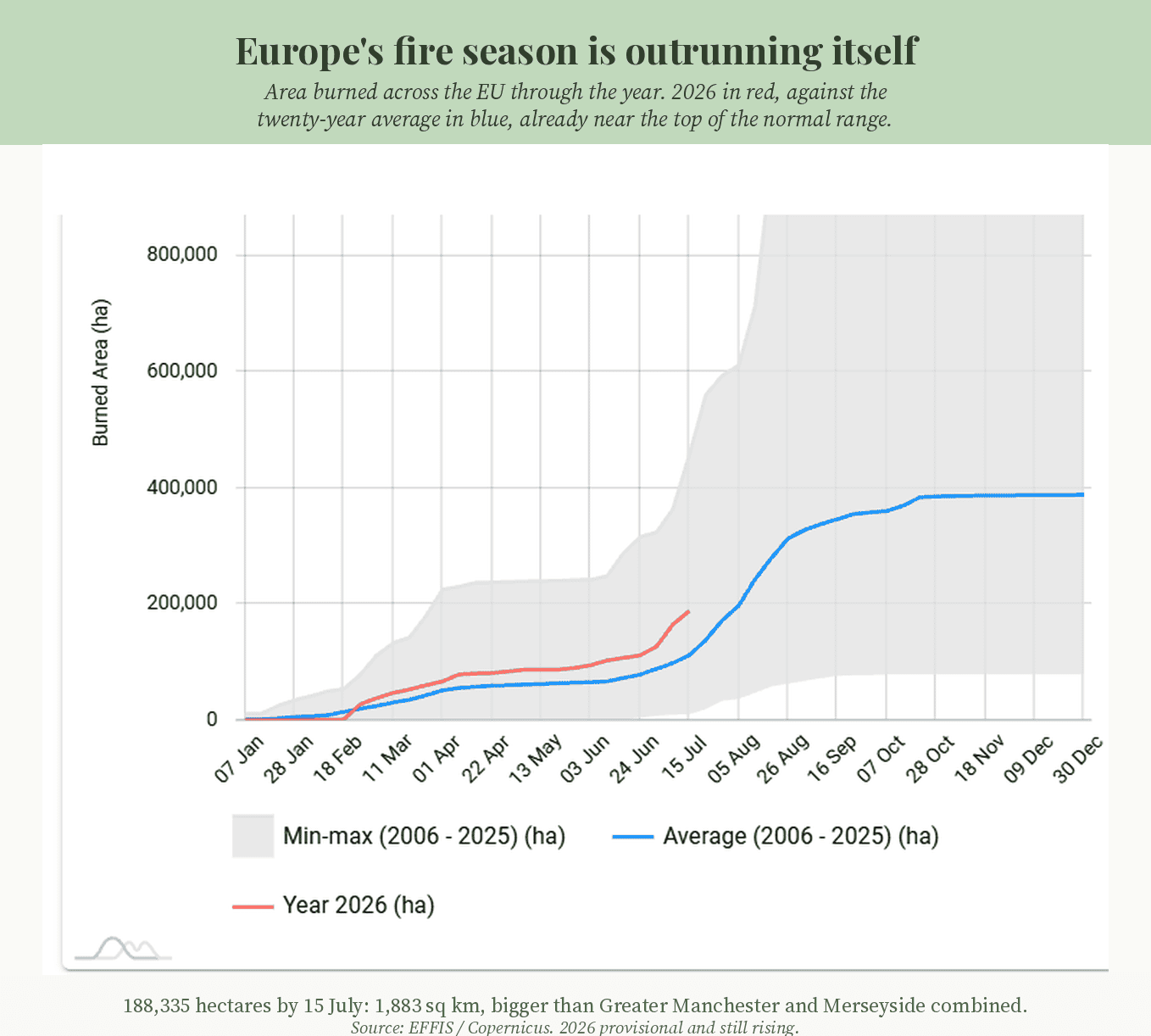
By 19 July, 14,489 hectares had burned in Italy since the start of the year, well above the twenty-year average for the date. The number of fires is the sharper figure: 125 detected, compared with a historical average of 65. The season began weeks earlier than it should have. That is 145 square kilometres, two and a half Manhattans, gone by the third week of summer.
Across the EU, the total had passed 188,335 hectares by 15 July, well above the average for the date, and 1,883 square kilometres, bigger than Greater Manchester and Merseyside combined. Even though that is short of 2025, the worst year since European records began in 2006, when over a million hectares were lost. Italy’s own share that year was 843 square kilometres, close to double the year before, more than the whole of New York City
And that is still well short of 2025, the worst year since European records began in 2006, when over a million hectares were lost. Italy’s own share was 965 square kilometres, close to double the year before. Italy alone burned more than the whole of New York City, which is 784 square kilometres.
One figure to remember is last year’s total for Europe: 1.07 million hectares, or 10,700 square kilometres. For comparison, Abruzzo is 10,832 square kilometres. Nearly the entire region burned across Europe in just one summer.
Read the fire count rather than the hectares. Nearly twice the normal number of fires, by the first week of July, in a season officially three weeks old.
These are Copernicus EFFIS figures for Italy as a whole, drawn from satellite mapping, and they are provisional. There is no regional breakdown for Abruzzo in them. The size comparisons are mine.
The Argument You Will Have Afterwards
Within a day, people in the village will start guessing who caused the fire, a jealous neighbour, or someone wanting the land. The rumours spread quickly, but it’s important not to take part in them.
Not because the suspicion is baseless. Legambiente’s 2024 figures record 1,197 of 2,612 woodland fire offences as deliberate, around 46 per cent, and roughly 95 per cent of those cases are filed against persons unknown. But that is an investigation, and there is a service for it. If you saw something, the Carabinieri Forestali have a free national line, 1515, staffed around the clock. This is not a number to memorise alongside 112. It is one to look up calmly, days later, when you are describing what you actually saw: a car, a time, a plume starting in a particular place. You can ask to stay anonymous. What you saw is evidence. What you concluded over coffee is not, and repeating it can wreck a family who had nothing to do with it, in a village where everyone has to live together afterwards.
But these village rumours miss the real issue.
Only about 2 per cent of Italian fires are caused by natural causes. Nearly all the rest begin with a person. Somebody almost always lights it. That has been true for as long as records exist. What has changed is what happens next. A match in a damp wood in 1990 was a nuisance. The same match now lands in vegetation dried for weeks, in air that will not cool overnight, on a hillside nobody has cleared since the last shepherd left.
That change has been measured. Researchers found human-caused climate change made the fire weather behind the deadly fires in Turkey, Cyprus and Greece roughly ten times more likely. For Spain and Portugal, conditions now expected every fifteen years would have arrived less than once in five centuries without climate change, about forty times less often. Rural depopulation and unmanaged land made the fuel worse. And fewer than 2 per cent of Italy’s fires between 2007 and 2021 accounted for more than half of everything that burned.
Most fires are small and go out quickly. Only a few become the major ones we remember. What makes the difference isn’t the person who started the fire, but the heat, wind, and dry conditions.
So arsonists do exist, but they aren’t the only cause. They couldn’t have caused this much damage in a normal summer. They needed extreme heat and weeks without rain, which they didn’t create.
Why I Know Any Of This
I have been close to two fires and had to evacuate from both.
One ran along scrubland and up a hill in Rome, directly underneath the school where I was teaching at the top, where, of course, we had to evacuate the children.
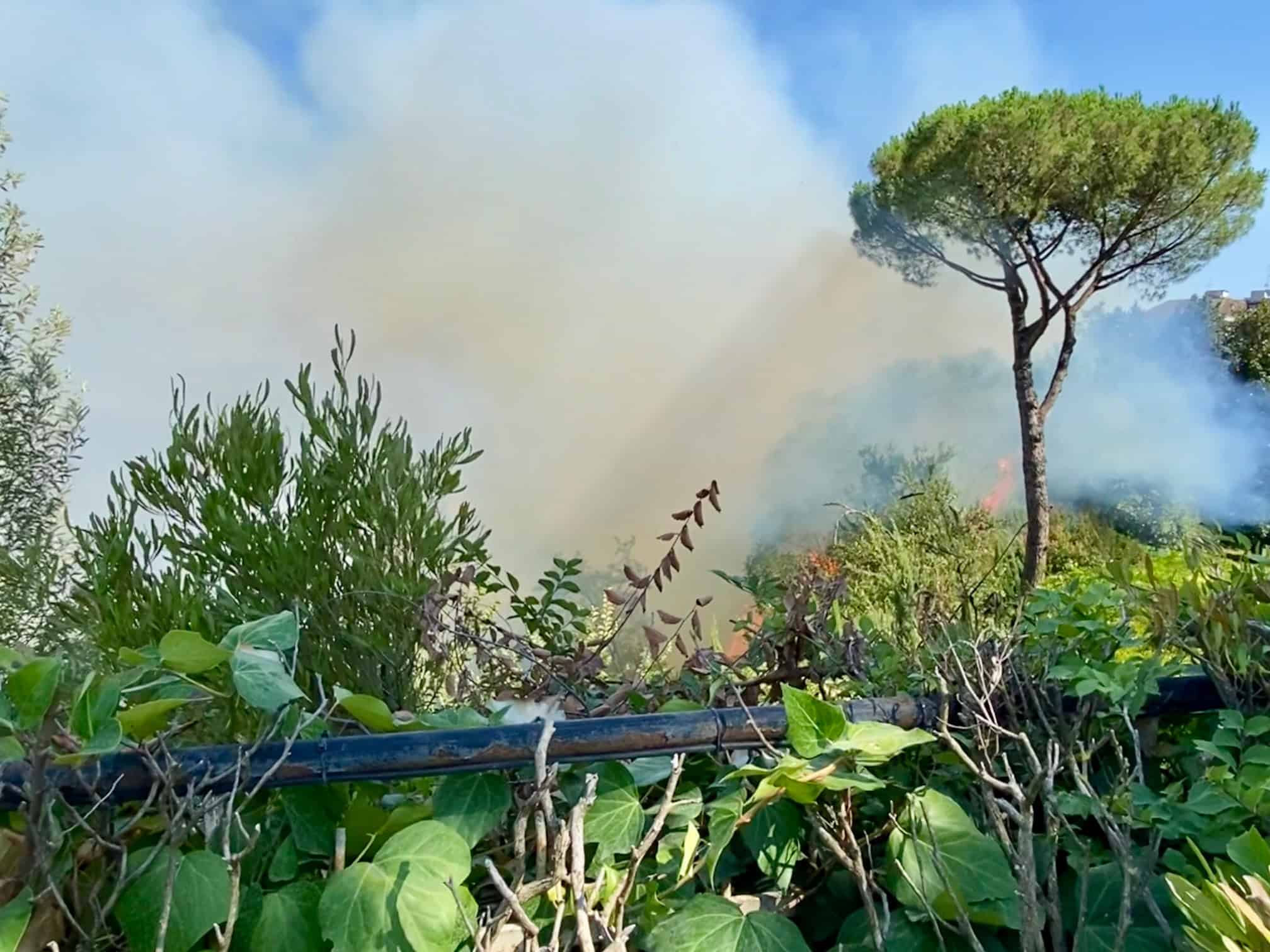
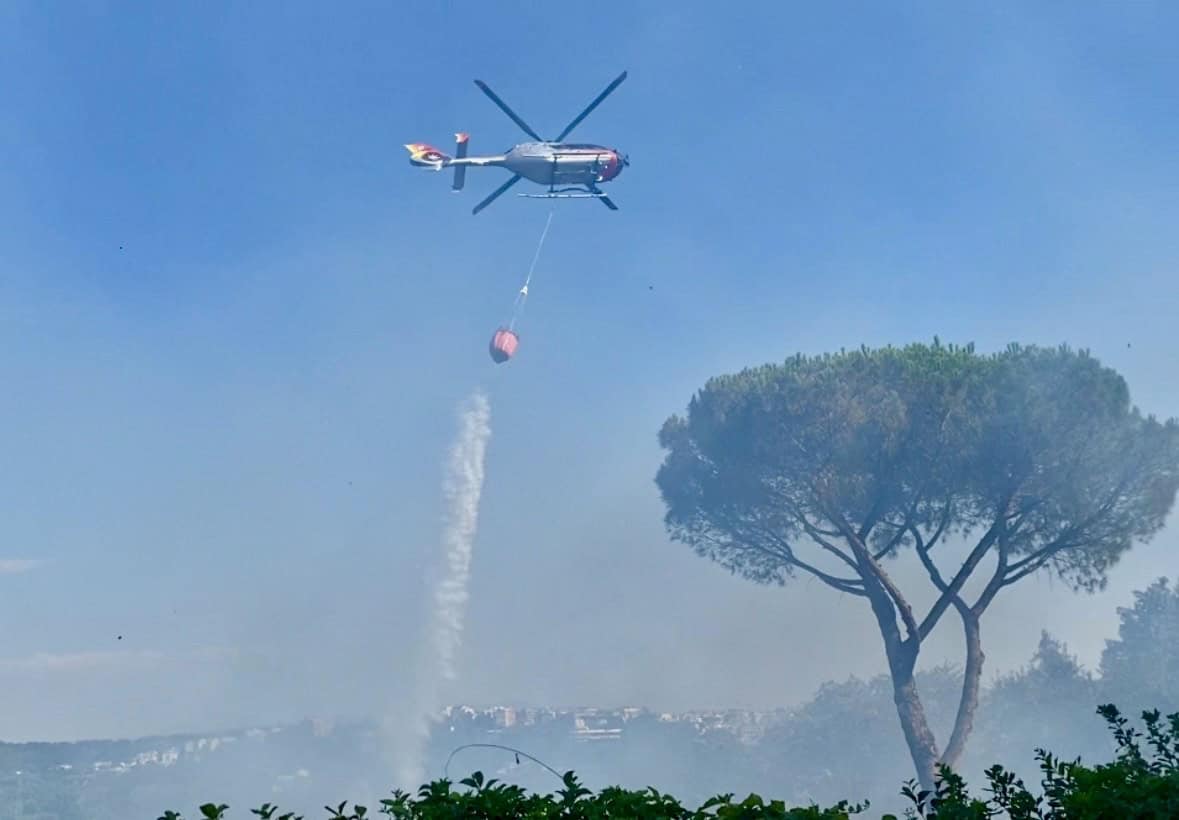
The second came to my village, Bascianella, and we drove out along a road with flames on both sides.
People often picture wildfires, but it’s really the sounds that stay with you. The terrible noise of crackling trees as they burn, heightened panicky voices, and silence as you and your neighbours watch the fire being water-bombed, hoping, praying or whatever you turn to when feeling helpless. Trying to sleep after being evacuated as a fire is near your village is one of the hardest experiences I’ve had. It’s the longest wait for the news in the morning. Did the village and my house survive?
Afterwards, there is the stench, and it is not a bonfire. People assume woodsmoke, something autumnal, almost pleasant. It is nothing like that. Around our village, they also dropped foam, this and dead spirits of trees and rubbish all muddled together to create an acidic smell that caught at the back of your throat and stayed there. It seeps back into your clothes as you dry them, so everything gets dried inside for a while. We went to stay with friends for a week. My son watched the hills for years.
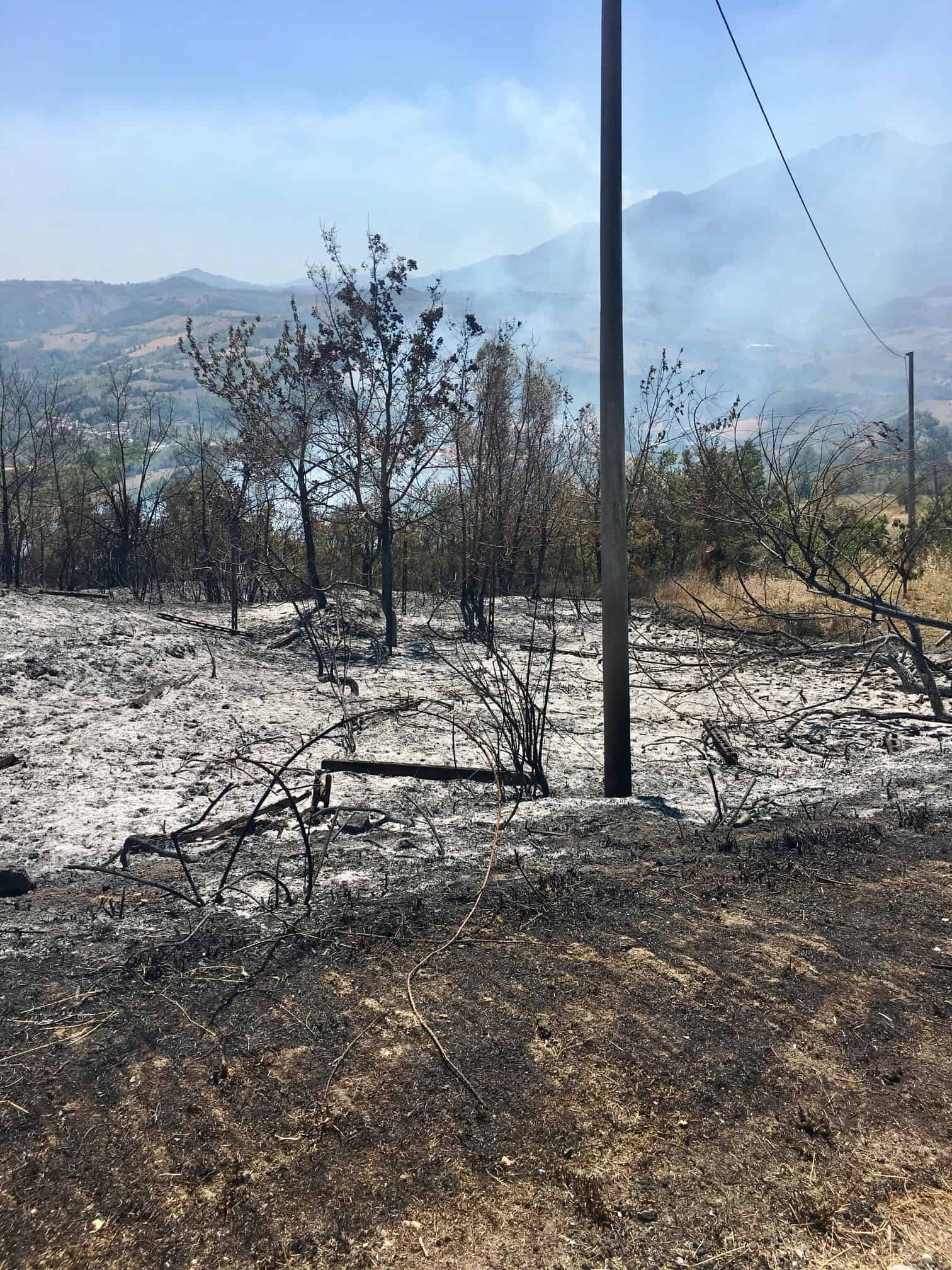
Eight years on, some of it came back. The olives were tough, as olives are. The apples did not survive. The wild grapes, the borage, the poppies and the herbs have not returned at all.
Now I can recognise a Canadair fire plane from far away, even before others notice. It has a deep drone, with propellers instead of jets, flying low and slowly. You learn that sound quickly during a fire, watching them go backwards and forwards as they water-bomb the area, and it stays with you.
I want to be clear: these conditions result from ignoring science and the climate crisis. They aren’t caused by random weather, bad luck, or just one person with a lighter. For decades, governments were warned by experts but chose not to act because it was easier and more profitable to do nothing. The science was always there, but it was ignored, and it’s still being ignored by those who would rather exploit other places than protect this one.
That is what I think, standing on a hillside where the herbs have not grown back in eight years.
Ringing 112 quickly is what we can do. It is nothing. It is the difference between a hectare and a hillside. But it is a small thing to hold against a large one, and I would be lying if I pretended otherwise. Put the number in your phone anyway. Make sure your neighbours have it. Then keep asking, loudly, why the summers are like this and giving your short answer.
112. Put it in now.

Author: Sam Dunham
Sam is a freelance SEO content creator and IGCSE Geography and English teacher in Rome. She also runs the Life In Abruzzo Cultural Association, sharing stories and insights about this captivating region. Alongside raising a teenager, Sam hosts guests at her family’s traditional home, the Little House of the Firefly in Abruzzo, offering a warm welcome and insider tips on local culture, food, and hidden gems.





This is an absolutely incredible resource. I am not yet in Abruzzo but live in fire country in the US (breathing smoke as I type). I read a lot of content about fire safety. This is hands down the best thing I’ve ever read.