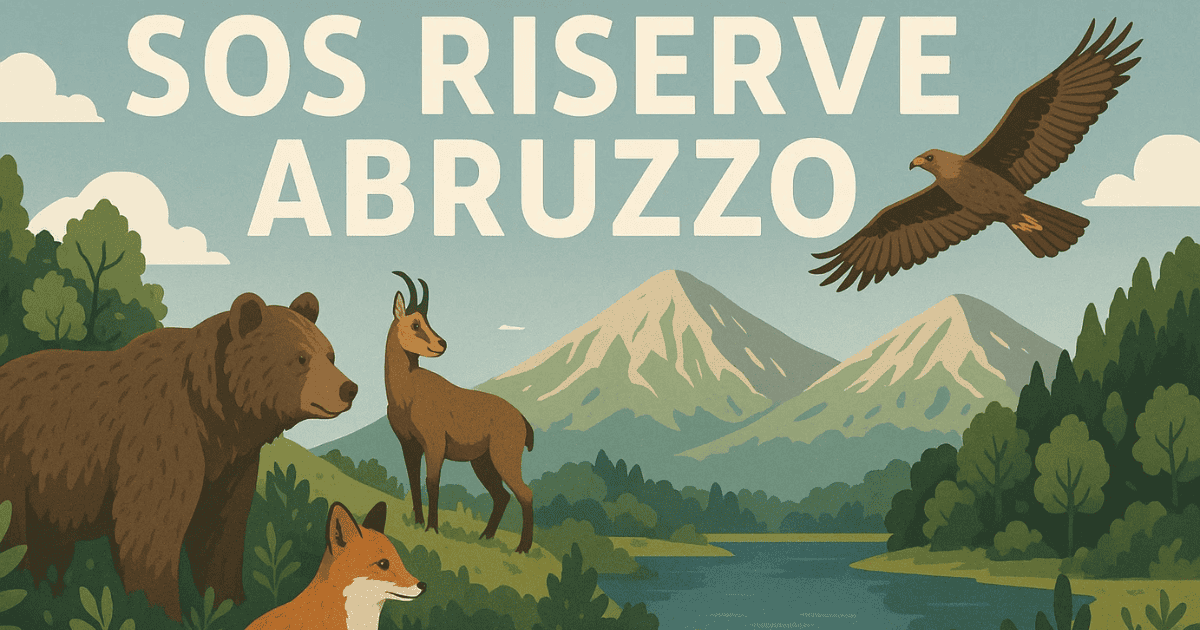
Three good things have happened in Abruzzo this summer. There are more Marsican bears than anyone knew. A stolen nature reserve came back. And a woman won the right to keep hunters off her own land after fighting for five years.
Then I read what the government’s own scientists told the region’s government in March, and what the ‘Region’ did next.
This is long. If you read one part, make it the one about the quail.
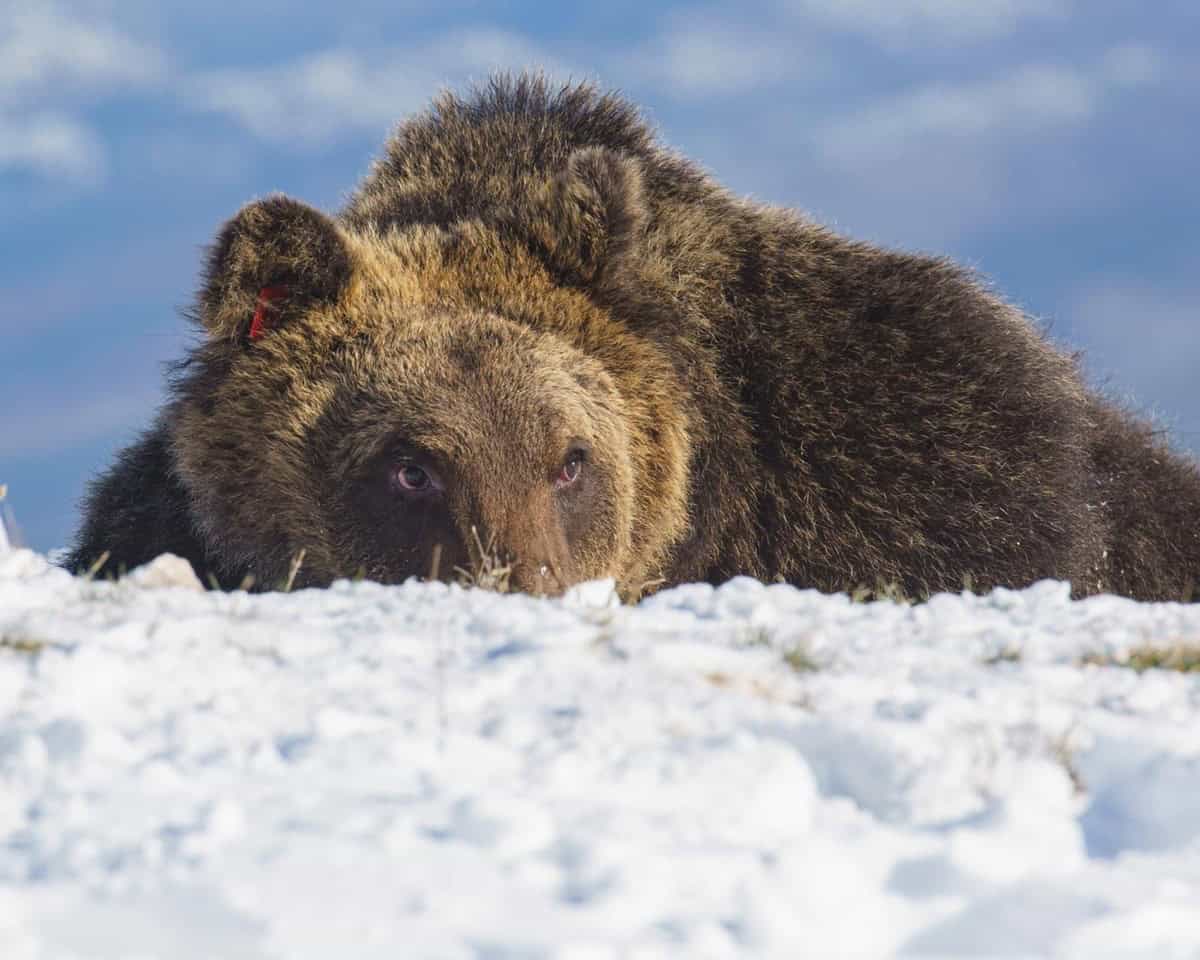
There are 81 Marsican Bears
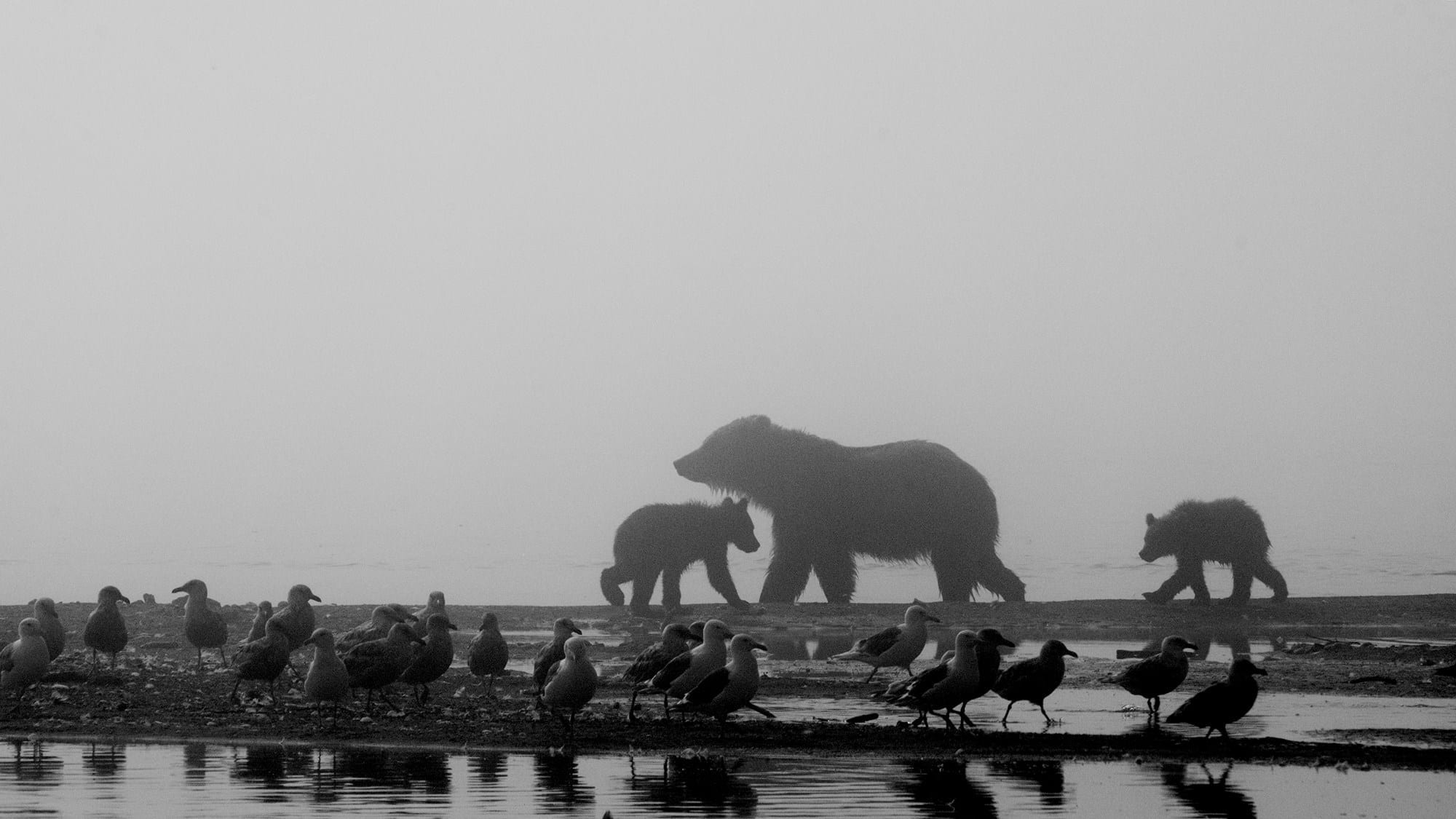
Eighty-one Marsican brown bears live in the central Apennines. Forty-three females, thirty-eight males. The true figure lies somewhere between 73 and 88.
The work was done by the state wildlife agency and the national parks, with the bear monitoring networks and the forestry police, across six thousand square kilometres of Abruzzo, Lazio and Molise, an area about the size of Delaware. They gathered hair, one strand at a time, and read the DNA. It is the first count ever made across the whole of the bear’s range, and the first proper count of any kind since 2014.
People watch these bears constantly. Every female with cubs, every death, every sighting goes on the record. But watching is not counting. The last estimate was twelve years ago; it covered only the national park, and it found between 45 and 69 animals. So when you read that the population is steady, that is the park compared with the park. It is the only comparison anyone can make.
The number to hold on to is the small one. About sixteen bears now live outside the park, out on the edges. They are spreading. Remember that. It matters later.
The Borsacchio Reserve got its Stolen Acres Back
The Borsacchio Reserve sits on the coast at Roseto degli Abruzzi. It covers 1,140 hectares, about 2,800 acres.
In December 2023, in the middle of the night, the Region cut it to 24.7.
The cut arrived as a late-night amendment to the regional budget. It cleared the way for building on the coast.
What followed took two years. Thirty-two thousand signatures. More than six hundred associations. Two letters from the Environment Ministry in Rome. A case in the administrative court.
On 3 July this year, the Region gave way. The protection is back, across the whole of the original reserve. The court case is still listed, and will be heard in February 2027.
One Woman, and The Men With Guns
If you own land in Abruzzo, hunters may walk onto it and shoot.
You cannot stop them. Not with a sign. Not with a hedge. Not by asking. Not by standing there.
Your land is open to them from October to January, three days a week. The only person you may turn away is one without a licence.
Article 841 of the Italian Civil Code says an owner may close their land at any time. Article 842, in the very next line, states that an owner may not prevent people from entering to hunt.
Two articles, one after the other. The first gives you the right, the second takes it away, for one kind of person carrying one kind of object. You may lock your gate against walkers, against birdwatchers, against your neighbour, against the whole world. You may not lock it against a man with a gun.
Hunting is banned in the parks and reserves, and wherever bears are known to be. Beyond that, your land is closed only if you fence the entire boundary to four feet, or if a stream runs round it at least five feet deep and ten feet wide. A fence costs thousands. That is the real exception. Money.
The article dates from 1942. Italians have tried to repeal it since 1990, by referendum and by bill, but have never succeeded.
Then a woman in Pescara won.
In 2021, Abruzzo’s ornithological society asked landowners to apply to have their land taken off the shooting map. Dozens applied. The Region turned down almost all of them, using the same line every time: too much land would be withdrawn beyond a 30 per cent limit.
One woman kept going for five years.
In May, she won. The court in Pescara ruled that a moral objection to hunting is a sufficient reason to ask, and that the Region cannot say no without showing, field by field, why excluding that particular piece of land would wreck the plan. The 30 per cent figure can no longer be waved at people as a formula.
The court leaned on Strasbourg, where the European Court of Human Rights has held that no one must endure hunting that offends their convictions on their own land, since hunting is mostly a pastime. Italy’s highest administrative court said much the same earlier this year. Together they set a rule that binds every region in the country.
A door shut in 1942 is now, at last, ajar.
Except the door has no handle
To take your land out, you apply to the Region. There is a window. It opens for thirty days when a new wildlife plan is published, and the plan runs for five years.
Abruzzo’s plan ran from 2020 to 2024. It expired in 2025. The Region was not ready with a new one, so last autumn it extended the old plan to 2027. Not revised. Extended. Just as it was.
No new plan. So no window. So no application, and nothing for the Region to refuse.
Nobody is counting, and that is the point
Once you notice the frozen plan, you start noticing the pattern it belongs to.
That plan required forty things to be measured every year and published. How many of each species there are. What is being done about poaching. Whether lead shot is being phased out. How much hunters actually know. Abruzzo’s ornithological society, the bear charity Salviamo l’Orso and the animal protection league, who took the extension to court last autumn, say it was not done.
The plan’s hunter count is based on the 2017/18 season. That is the figure Abruzzo is still using in 2026. Nine years old, and current by decree.
Meanwhile, more than 1,300 hectares of Abruzzo were built on between 2020 and 2024, some 3,200 acres of habitat. And the bears turned up at Olmo di Bobbi and at the Piano delle Cinque Miglia.
Those are the sixteen animals from the top of this piece. They are standing on ground governed by a map drawn before they arrived. The Region knows. The shooting calendar says so out loud: pending redefinition of the zoning.
Now watch what happens when counting would actually cost somebody something.
Shoot a woodcock in Abruzzo, and you must keep the right wing. You hand in the wings by 20th February with the place, date, and time, and a feather preserved in alcohol so the bird can be sexed genetically. Technicians sort the wings into young birds and adults, because a one-year woodcock carries different markings, and the ratio tells you whether the birds bred well.
I thought this was the one piece of real science in the file. It is not there for science. It is the entry ticket. In the words of ISPRA, the government’s own wildlife science agency, the January extension is possible only in districts that run a monitoring programme. No wings, no January woodcock. The wings buy something. That is why anyone bothers.
Now look at the fieldfare. Nobody has written a management plan for the fieldfare. There is nothing to unlock. So the fieldfare gets a pencil mark on a card, handed in at the end of the season and typed into a computer by 30 April, four months after the shooting stopped.
Nobody counts the birds. Nobody checks the card.
They know perfectly well how to build a monitoring system. They built one for the bird whose extra fortnight needed paying for.
And here is what the cards say when someone reads them. Abruzzo’s own returns show woodcock shot from hides: 57 birds, then 89, then 129.
Shooting woodcock from a hide is a criminal offence, and has been since 1992. ISPRA had to ask the Region to write the ban into the calendar and enforce it, because nobody had. The hunters wrote the kills down themselves, in ink, on the forms. The number tripled. Nothing happened.
What the Scientists Said
Every year, before it sets the shooting season, the Region must send a request to ISPRA to approve its dates
ISPRA is the body the Italian taxpayer pays to count the birds, follow the migrations, and say what can safely be shot and when. It is not a campaign group. It is the referee.
The Region asked on 23rd February. ISPRA answered on 16th March, in fifteen pages, signed by the head of migratory birds and by Italy’s most senior wildlife scientist. I have read it. Here is what they asked for, and what the Region did.
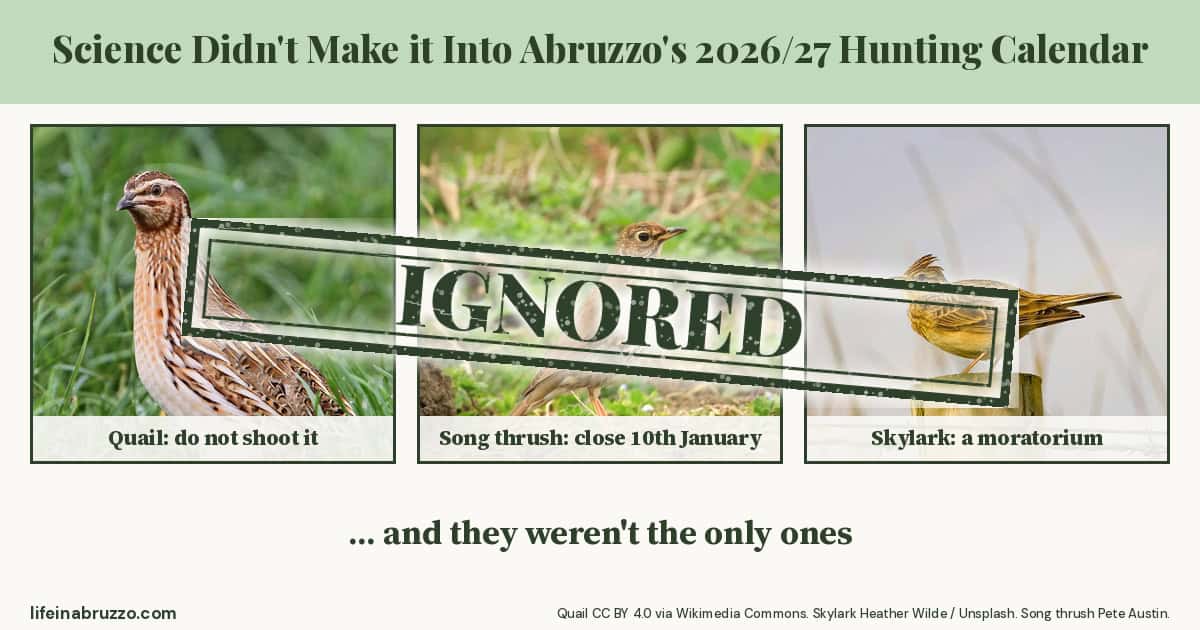
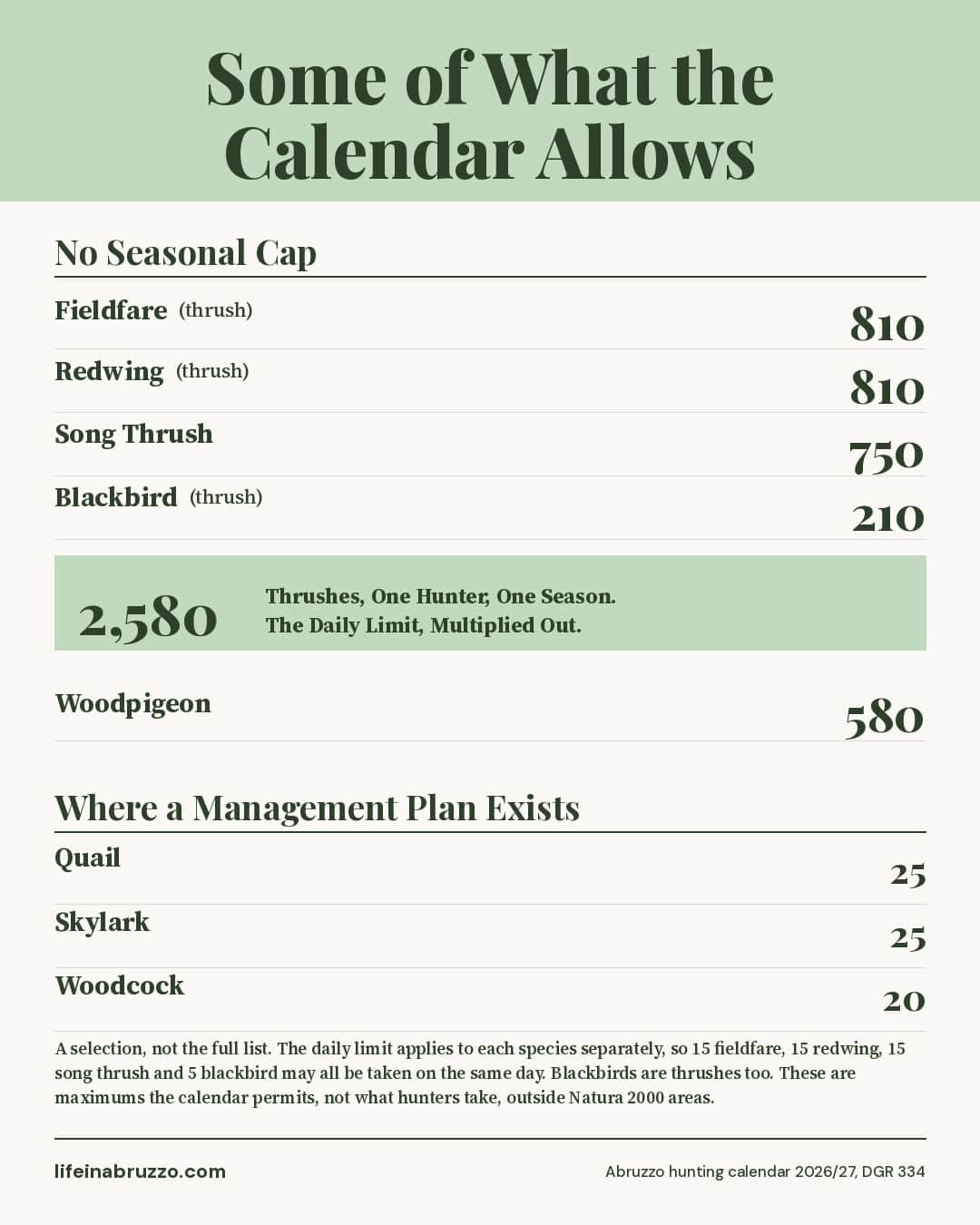
Quail. ISPRA said not to shoot them at all this year.
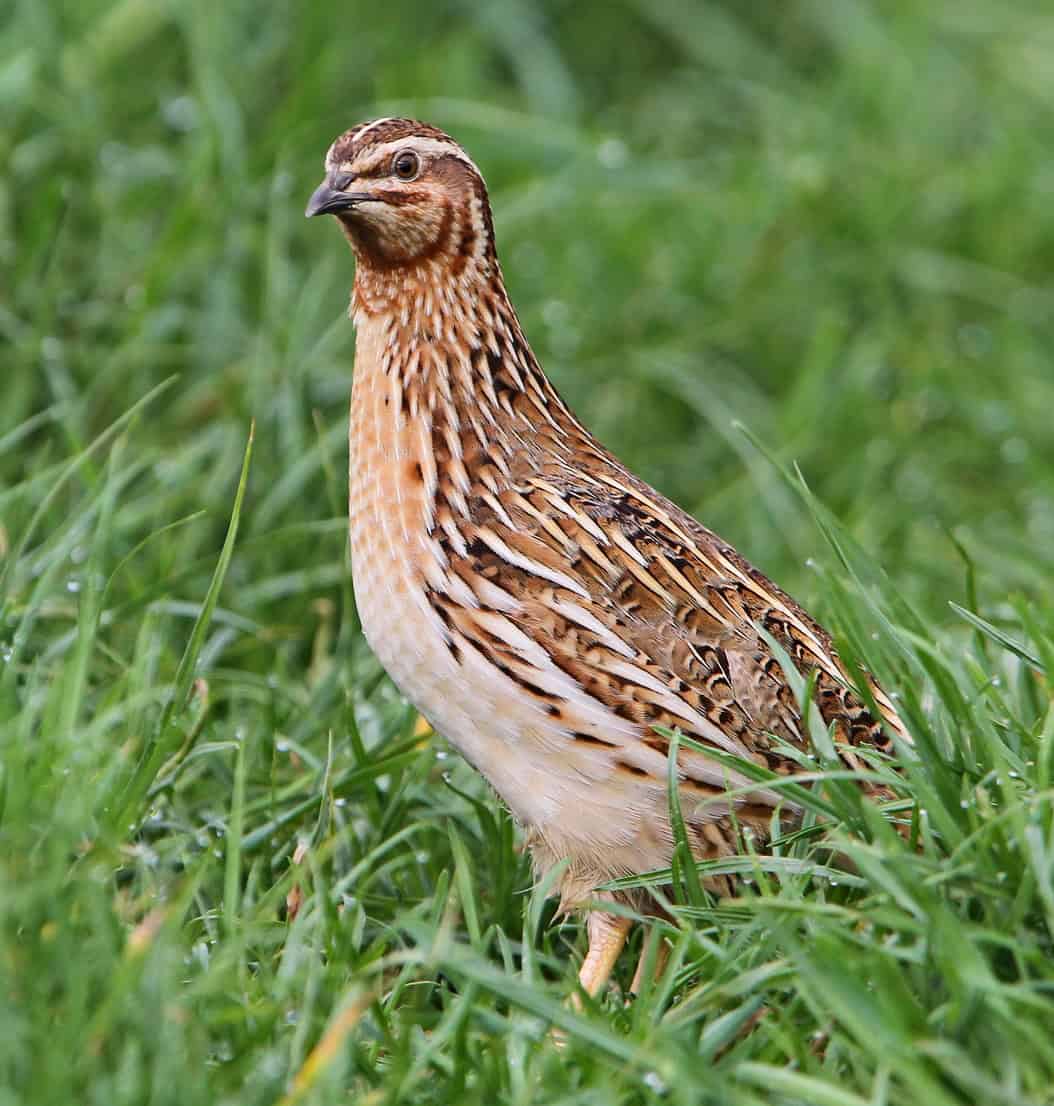
Look at why. In September and October of 2014 and 2015, hunters in Abruzzo shot 1,325 quail, then 2,747. In the same two months of 2023 and 2024, they shot 371 and 64, respectively.
Sixty-four birds. The hunters went out, and there was almost nothing there.
The season opens on 20th September.
Thrushes. ISPRA said to close all three on 10th January. The birds start moving north to breed in the second week of January, and European law requires complete protection once they do. Going past 20th January, ISPRA wrote, would break Italian law and a European Court of Justice ruling from 1994.
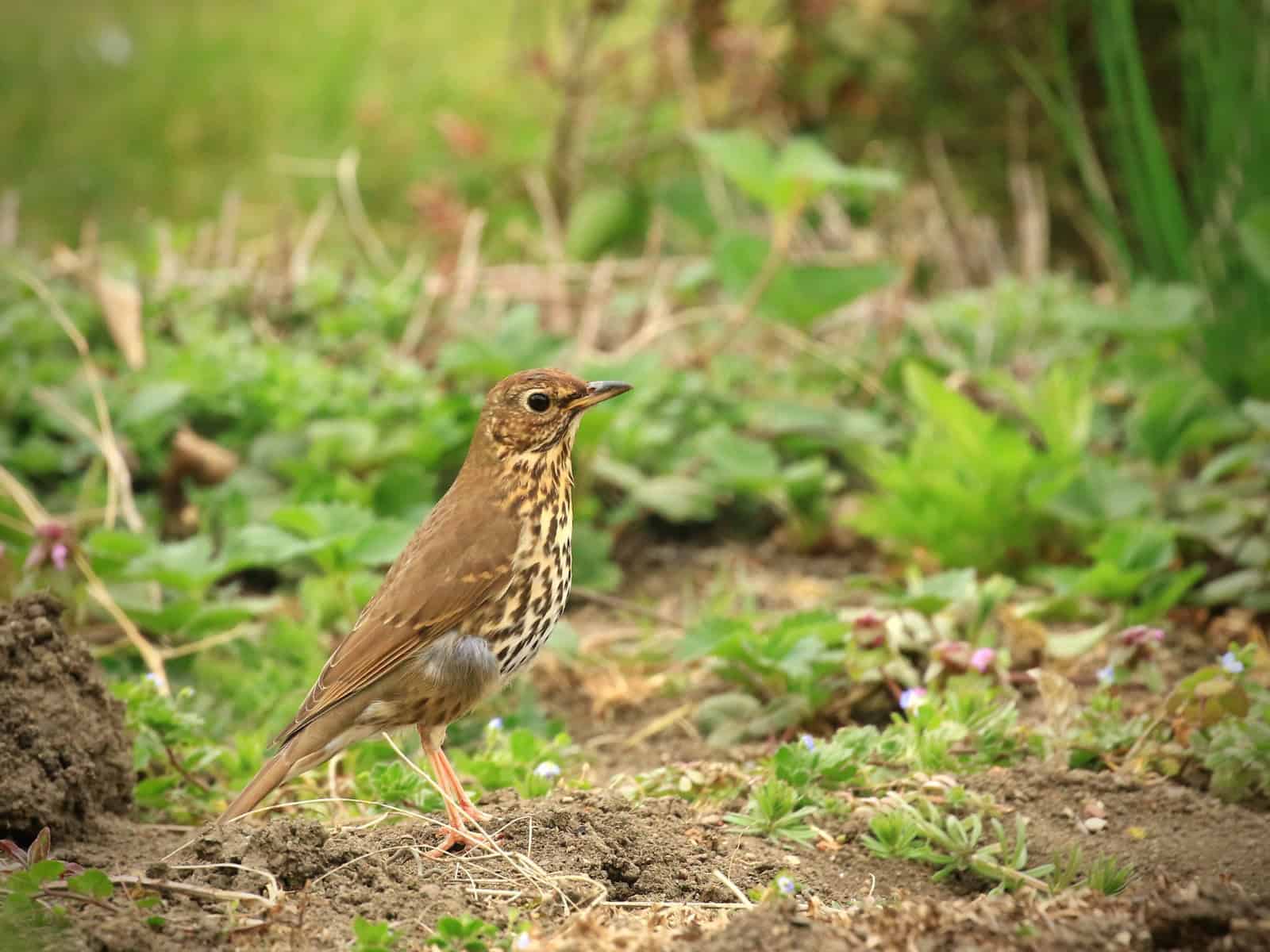
The Region set 20th January for the song thrush, and 31st January for the fieldfare and the redwing. Eleven days past the line its own scientists called unlawful.
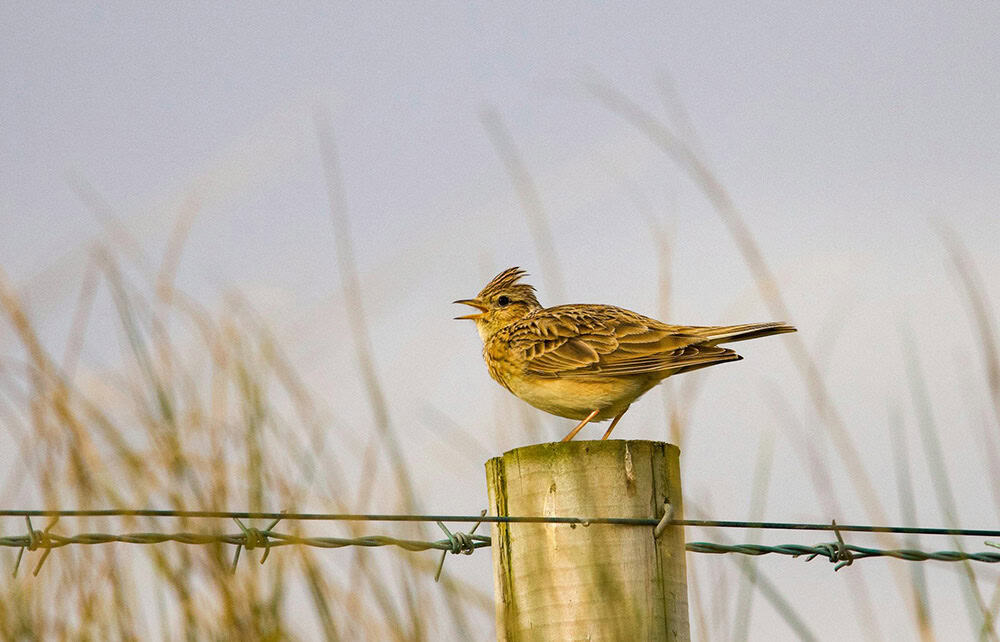
Skylark. ISPRA asked for a moratorium. Stop shooting it, for now.
The reason sits in the annex, and it is the most useful thing in the whole file. In 2021, Europe banned the shooting of turtle doves on the western flyway and merely capped the numbers on the central-eastern one, which crosses Abruzzo.
The ban worked. Western flyway: recovered to its highest level since 2009, and the trend flipped from decline to increase.
The cap did not. Central-eastern flyway: the lowest figure in the entire series in 2024, and the trend got worse.
Same bird. Two policies. One outcome each. ISPRA said the skylark should get the ban, not the cap, because we have just watched the cap fail.
The Region gave it just the cap.
And the rest, briefly. On waterfowl, ISPRA compared the limits in the calendar with how many ducks are actually shot in Abruzzo, and called the limits so high as to be, in fact, ineffective. On woodcock, it said close on 31st December and cut the daily bag from five birds to three; the Region set 20th January and kept five. On dogs, it said 22nd August is too early because some birds have not finished raising their young; the Region set 22nd August.
The Lead
Fifty-three golden eagles and griffon vultures were found dead or dying in Abruzzo and Lazio and sent for testing. At least 23 of them contained lead. Forty-three per cent. ISPRA says the real figure is higher because, for many birds, only one tissue could be tested.
Lead is not only a bird problem. European food safety experts have found lead exposure four to seven times higher in adults who eat a lot of game, which means hunters and their families are among the worst affected by their own ammunition.
ISPRA’s conclusion: hunting with lead is not sustainable.
Abruzzo has banned lead in wetlands, and for stalking deer and boar with a rifle. For boar drives, where most of the shooting happens, it only recommends against it.
And there is one more measure, written into the decree. It is compulsory to publish a link to ISPRA’s website.
That is the answer. Include a hyperlink.
Who is Deciding This
None of the above is a local accident.
Abruzzo’s regional government was put in place by fewer than three in ten of the people entitled to vote. Turnout at the March 2024 election was 52.19 per cent, the lowest the region has ever recorded, and the winning coalition took 54.67 per cent of the votes cast.
On 23rd June this year, Rome rewrote Italy’s 1992 Wildlife Law. The Senate passed it, 80 votes to 56.
The first name on the bill is Lucio Malan. He leads Fratelli d’Italia in the Senate. That is the party of the prime minister, Giorgia Meloni. The leaders of the other governing parties signed it too. All three voted it through. The opposition voted against and said it broke the constitution.
One line in it matters here. ISPRA’s advice ceases to be binding. The bill now goes to the lower house.
The same coalition runs Abruzzo. Marco Marsilio, the president, is from Fratelli d’Italia. His deputy Emanuele Imprudente holds farming, hunting and fishing, and signs the calendar. He was elected for the Lega.
You do not have to guess how close the hunters are to all this. They said so themselves. Welcoming this year’s calendar on its own website, the national hunting federation wrote that it was not entirely satisfied, that not every request had been granted, that it valued the steps the Region had taken, and that it would be back for more during the season. Then it thanked the assessor by name.
Nobody else gets to ask for changes mid-season.
Eighty-one
Every one of the three good things at the top of this piece was paid for by somebody. Thirty-two thousand people signed for the Borsacchio. One woman gave five years to a court case and won a door with no handle behind it. The bear count was done by people gathering hair, one strand at a time, across an area the size of Delaware, because nobody had bothered for twelve years.
The sixteen bears on the edges are the ones that will meet all of this first. They are walking out of the park onto a map that was drawn before they existed, in a region that has decided, for now, that it would rather not know.
Eighty-one is wonderful news. It is also the only number that got through.
A Note on Counting Hunters
Abruzzo’s wildlife plan gives two different figures for its own hunters, on the same page. Section 3.5 says 10,332. Table 7 underneath it, listing all eleven hunting districts, adds up to 9,226. The plan’s own trend calculation needs the larger number, because a fall of 26.98 per cent from the 14,136 that ISTAT counted in 2007 only works with 10,332.
Both figures are from the 2017/18 season. The average age given is 57.7.
There is no newer count. The plan that carries the figure was extended rather than rewritten, so 2026 is being managed on a 2017 headcount. Carry forward the decline the plan had already measured, and you would expect something near 8,000 today, about one person in 156. That is my arithmetic, not a count, and I offer it only as an estimate.
Counting hunters is genuinely awkward. Gun licences overstate the number, because a licence lasts five years and many holders do not take out a hunting permit in any given season. The regional tesserini, issued annually, are the only real measure. Abruzzo has not published a current total.
The district figures, for 2017/18: Pescara 1,859, Salinello 1,410, Vomano 1,195, Vastese 1,089, L’Aquila 904, Chietino-Lancianese 800, Avezzano 598, Roveto Carseolano 579, Sulmona 462, Subequano 186, Barisciano 144.

Alongside raising a teenager, Sam hosts guests at her family’s traditional home, the Little House of the Firefly in Abruzzo, offering a warm welcome and insider tips on local culture, food, and hidden gems.

Author: Sam Dunham
Sam is a freelance SEO content creator and IGCSE Geography and English teacher in Rome. She also runs the Life In Abruzzo Cultural Association, sharing stories and insights about this captivating region. Alongside raising a teenager, Sam hosts guests at her family’s traditional home, the Little House of the Firefly in Abruzzo, offering a warm welcome and insider tips on local culture, food, and hidden gems.