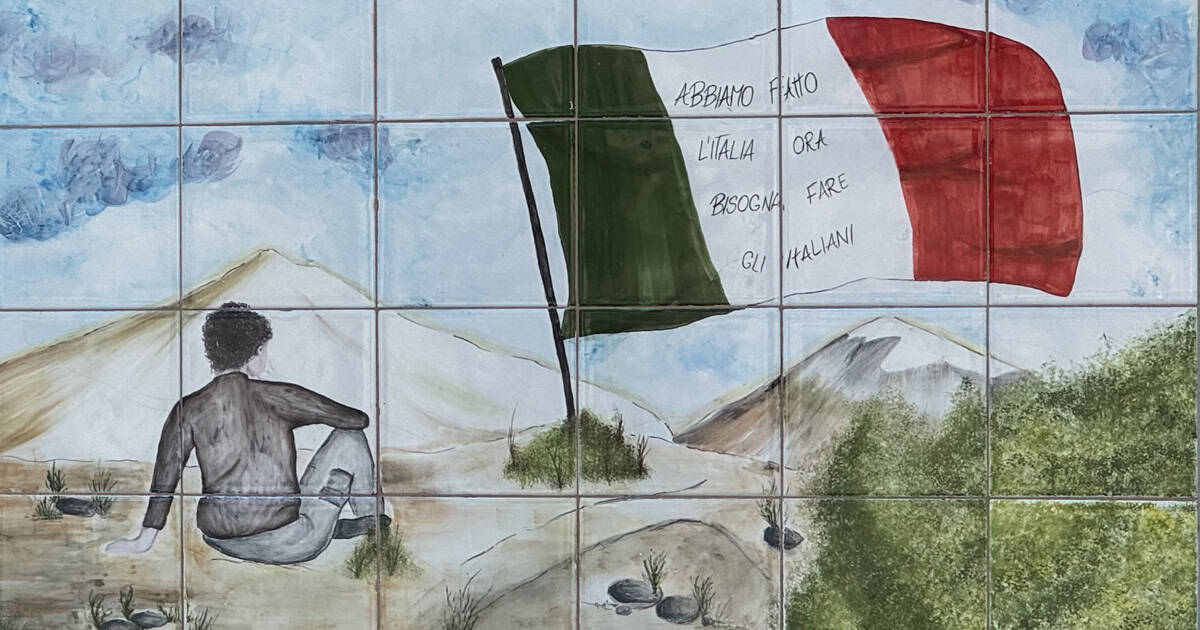
Ceramic, I Muri Raccontano, Villa Ilii, Colledara
Eighty years ago today, on 2 June 1946, Italians went to the polls and made a decision that shaped the country we know today. Their choice influenced modern Italy, its constitution, its institutions, and even its flag.
Most of Italy voted for the republic, but Abruzzo, although divided, chose to keep the king. Across the country, the republic won about 54.3% of the vote, while the monarchy got 45.7%. In Abruzzo, the monarchy received 53.2%. Voter turnout was nearly 88%.
L’Aquila and Chieti supported the king, while Pescara and Teramo chose the republic. The province of L’Aquila was part of the monarchist area. In the city of L’Aquila, 53.30% voted for the monarchy. In mountain towns like Tagliacozzo and Pescasseroli, support for the king reached 81%. Sulmona voted the other way, along with Pratola Peligna and Celano. The city of Chieti voted 78.20% for the king, with Lanciano at 66.82% and Fara San Martino at an extraordinary 92.42%!
Why would communities so close to the suffering of the war vote to keep the crown that had stood beside Fascism? The answer lies in the land. In rural and mountain areas, the Church’s influence ran deep, and the old social order held firm. The king was the known quantity, part of the natural way of things. The republic was unknown, and for people let down by past promises, the unknown was a gamble not worth taking. They chose the certainty they knew.
Today, President Sergio Mattarella leads the Republic and is widely respected in Italian public life. As a constitutional lawyer and former member of Italy’s highest constitutional court, he is seen by many as a steady and unifying figure above party politics. He did not want a second term and made that clear, but agreed to stay when the parties could not agree on anyone else. His quiet sense of duty has only increased the public’s trust in him.
How much do you actually know about the birth of modern Italy? Here are five questions that go deeper than the usual facts and explore the real history behind the celebration.


Alongside raising a teenager, Sam hosts guests at her family’s traditional home, the Little House of the Firefly in Abruzzo, offering a warm welcome and insider tips on local culture, food, and hidden gems.

Author: Sam Dunham
Sam is a freelance SEO content creator and IGCSE Geography and English teacher in Rome. She also runs the Life In Abruzzo Cultural Association, sharing stories and insights about this captivating region. Alongside raising a teenager, Sam hosts guests at her family’s traditional home, the Little House of the Firefly in Abruzzo, offering a warm welcome and insider tips on local culture, food, and hidden gems.