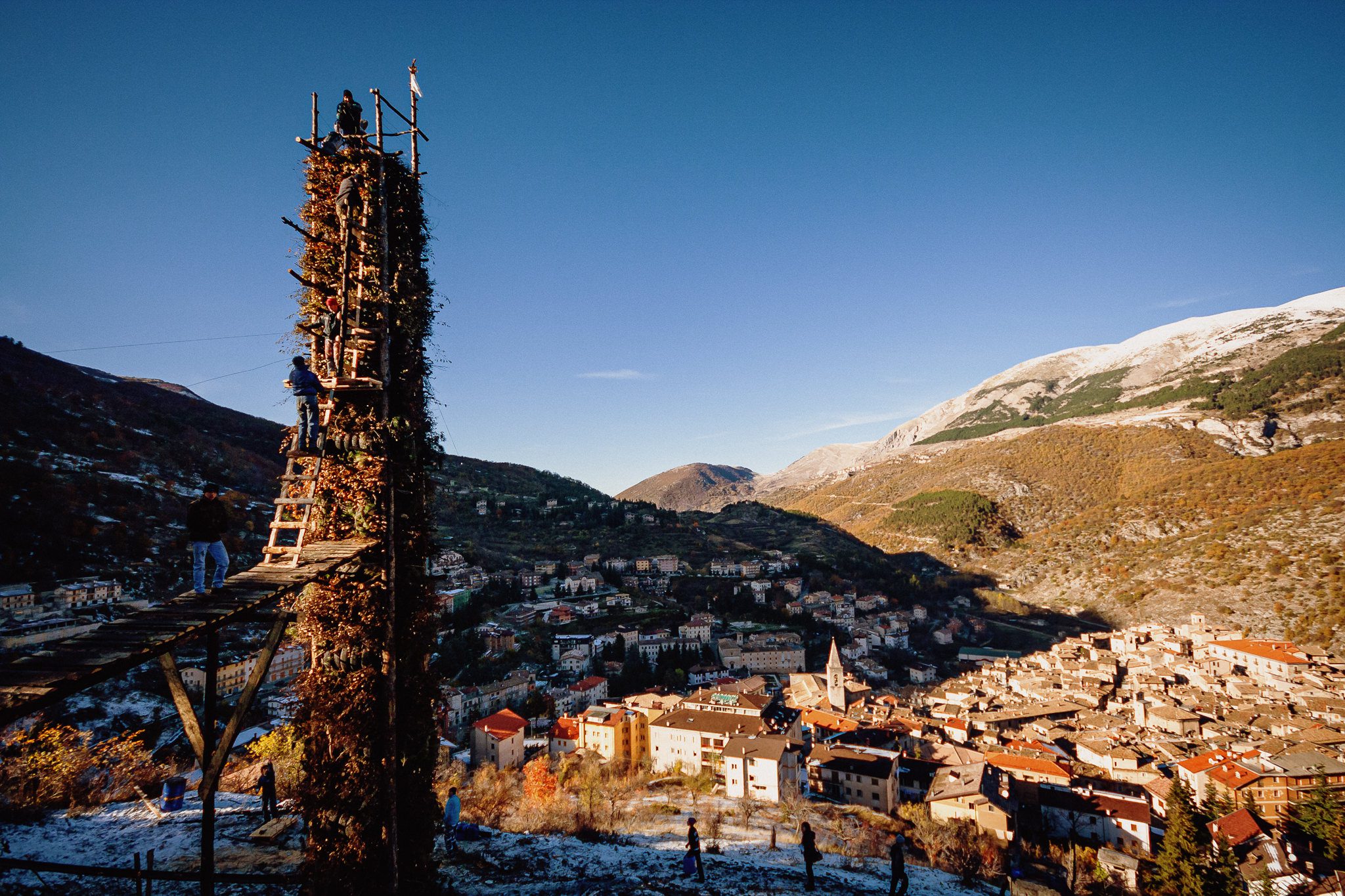
In Abruzzo, healthcare once arrived on foot, or if a midwife was lucky, by mule.
Before there were clinics, ambulances, or paved roads, care was provided by women who understood what needed to be done and stayed until the job was finished. They were known as mammane, levatrici, and later ostetriche condotte. In hospitals and charitable institutions, they worked as infermiere, assistenti, and suore-infermiere.
They were not figures of folklore. They were workers, witnesses, and essential infrastructure.

Francesco di Paolo da Montereale, Natività della Vergine at the Museo Nazionale d’Abruzzo (MuNDA), L’Aquila immediately shows this ongoing tradition. It depicts the Birth of the Virgin Mary, but the care shown is familiar and straightforward. Under the angels, women get water and linens ready, help the mother, wash the baby, and stay close. There is no dramatic rescue or single person taking charge. Even when the child is the Madonna, the work of care remains the same. Strip away the halos, ornate, rich brocades and bed, and this could be any birth in Abruzzo, centuries apart.
Before Hospitals: Birth as Women’s Work
Until the early twentieth century, most Abruzzese women gave birth at home. Geography, poverty, and distance made hospital births rare, especially in hill towns and mountain villages. The woman associated with birth assistance was often referred to simply as “la mammana”.
“Donna pratica nell’assistenza al parto.”
(“A woman experienced in assisting childbirth.”)
Her role was practical and continuous:
- monitoring labour,
- helping the baby breathe and stay warm,
- watching the mother during the dangerous hours after delivery.
This knowledge was not symbolic or ritualised. It was learned by repetition and carried through generations.
When was the midwife called? A Continuum of Care
The midwife was not always the first person present at a birth – but neither was she called only when something had gone wrong. Birth unfolded in stages, and care followed those stages.
In earlier periods, and in smaller communities, labour often began with the women already in the house: the mother’s own mother, sisters, neighbours, or an older woman who had attended many births. These women knew what early labour looked like and what could wait.
Only when labour advanced, lengthened, or required experienced oversight was someone sent to fetch the midwife.
“All’inizio si faceva da sole.”
(“At the beginning, women managed on their own.”)
This was not neglect. It was a form of shared knowledge. Midwives often looked after several households or hamlets, and women understood when a situation was something they could handle together and when it was time to call for more help.
By the late nineteenth and early twentieth centuries, this pattern shifted. As levatrici condotte were appointed and public-health awareness increased, midwives were called earlier and more routinely, especially in towns and larger villages.
“Quando iniziava il travaglio, si mandava a chiamare la levatrice.”
(“When labour began, they sent to call the midwife.”)
One thing stayed the same: care was always shared. Family and neighbours did not leave when the midwife came. They continued to help, learn, and support each other. The midwife joined a busy scene and took charge when her experience was most needed.
This is exactly what we see in the painting: not a dramatic arrival, but a continuum of women already present, each with a role.
Care of the Body: Warmth, Calm, and Familiar Remedies
The scene in the painting is not only about who is present, but about how the body is supported.
Basins of water, folded cloths, and vessels within reach were not just for show. They were part of a caring approach based on warmth, cleanliness, calm, and routine. Along with skilled hands and shared judgment, these simple household items often played a part in childbirth in Abruzzo.
These were not strong medicines, and they were not used to control or hasten birth. They belonged to the same category as clean linen or warm water: supports, not interventions.
“Per aiutare, non per forzare.”
(“To help, not to force.”)
A light infusion of camomilla (chamomile) might be prepared to calm anxiety or help a woman rest between contractions. Its value lay in its gentleness. After birth, when exhaustion set in and the body needed settling rather than stimulation, finocchio (fennel) was commonly associated with digestion and later with supporting milk production.
Malva (mallow), known for its soothing properties, was often used externally, such as in warm washes or compresses, to comfort women after childbirth. In colder seasons or mountain villages, keeping warm was very important. A little warm wine, sometimes with bay leaf, might be given after birth to help with cold and tiredness.
What is striking is not the range of remedies, but their restraint.
Experienced women and midwives were cautious. Plants believed to provoke bleeding, dizziness, or strong physical reactions were avoided around childbirth.
“Con il parto non si scherza.”
(“You don’t play around with childbirth.”)
These preparations were usually made by older women in the household or approved by the midwife when she arrived. They were not experiments. They did not replace judgment. They accompanied care rather than directing it.
When you look at it this way, the vessels in the painting Natività della Vergine are not just symbols. They remind us that even in a sacred birth, care is still about tending to real physical needs.
Why care mattered: mortality in context
The stakes were high.
In late-nineteenth- and early-twentieth-century Italy:
- Infant mortality was extremely high; in some periods, up to one child in five did not survive the first year.
Maternal mortality remained severe until antibiotics, blood transfusions, and modern obstetrics became widespread in the mid-twentieth century.
In rural Abruzzo, where doctors were distant and transport slow, survival depended on:
- cleanliness,
- warmth,
- observation,
- and knowing when to escalate care.
Midwives and carers did not eliminate risk. They reduced it, one birth at a time, night after night.
When Care Became a Public Service
By the early 1900s, Italian comuni began formalising maternal care through the condotta system. A levatrice condotta was a midwife appointed and paid by the municipality, responsible for a defined population.
Official notices describe these posts plainly:
“Sede di levatrice condotta, stipendio annuo…”
(“Municipal midwife post, annual salary…”)
This was not the start of care, but its official recognition. What had always happened in kitchens and bedrooms now became a public responsibility.
How Much Were They Paid (then and now)
Archival notices from the 1930s for Abruzzo list annual salaries typically between:
- 2,500 lire per year (≈ €2,750–2,800 today)
- 3,000 lire per year (≈ €4,100 today)
- 3,500 lire per year (≈ €4,800–4,900 today)
(Conversions use official ISTAT historical revaluation coefficients and the fixed conversion 1 euro = 1,936.27 lire.)
Even when converted to today’s money, these are still modest amounts. They show both the poverty of the time and the long-undervalued nature of women’s care work.
The women shown in the painting at the Museo Nazionale d’Abruzzo are not just symbolic ancestors. They were real people doing the same work that was later listed in payrolls and contracts. Centuries passed between the scene in the painting and the 1930s salary notices of 2,500 to 3,500 lire per year (about €2,800 to €4,900 today), but the way care was given stayed the same.
The state did not create this work. It eventually acknowledged it.
“Senza di loro, non so come avremmo fatto.”
(“Without them, I don’t know how we would have managed.”)

Alongside raising a teenager, Sam hosts guests at her family’s traditional home, the Little House of the Firefly in Abruzzo, offering a warm welcome and insider tips on local culture, food, and hidden gems.

Author: Sam Dunham
Sam is a freelance SEO content creator and IGCSE Geography and English teacher in Rome. She also runs the Life In Abruzzo Cultural Association, sharing stories and insights about this captivating region. Alongside raising a teenager, Sam hosts guests at her family’s traditional home, the Little House of the Firefly in Abruzzo, offering a warm welcome and insider tips on local culture, food, and hidden gems.