
One of our absolute favourite things at Life In Abruzzo is connecting locals and visitors for unique, off-the-beaten-path experiences! Imagine trading skills instead of money—where volunteers swap their labour for a share of freshly harvested fruits. So, when Erika, an urban beekeeper from Rome and the garden curator at the renowned Villa Massimo, reached out looking for a chestnut trail in the Monti della Laga area of Abruzzo to forage and take home her bounty, we couldn’t wait to jump in and help! Here’s her story!
The first time that I truly noticed sweet chestnut trees was on a trip just outside the city of Corte, crossing the hills of Corsica. My partner’s father Ghjiseppu Orsolini, who literally knows every angle of the island, was telling us stories about the region. I asked him to stop because I wanted to look closer at the majestic trees standing on the roadside. They must have been hundreds of years old: impressive natural monuments made of silvery shining bark, some covering a dark black burnt inside, evidence of lightning strike. The old trees were surrounded by young trees even higher than the old petrified structures. These trees were growing out of the enormous rootstock that had developed below ground and that was holding the steep slopes together.
Only now do I recognize the structure of old chestnut plantings scattered throughout the entire forest. The trees had been abandoned a long time ago and local tree species covered the ground once more. This was on a tour through the upper hills of Castagniccia. It is said that the Genoese encouraged the growth of Castanea on the island, back in the 16th century when farmers and landowners were given the order to plant 4 trees per year: a chestnut tree, olive, fig and mulberry. The tree is scientifically known as Castanea sativa and it is a genus of the plant family Fagaceae, not to be confused with Aesculus of the family Sapindaceae. The chestnut groves served as an essential food source over hundreds of years in an area where it was difficult to grow cereals
Today we know that chestnut trees are also able to enhance water quality. They are multifunctional: cultural, ecological, landscape, productive and a symbol of rural life in mountain areas. They appeared in the Mediterranean around 4000 years ago, probably arriving from further East.
While hiking the Apennin mountains I often encounter old chestnut groves, but they are mostly private. I wanted to find someone who would invite us to come, appreciate the trees and collect some of the wonderful fruits. Early in September, I contacted Sam D. of LifeInAbruzzo and she connected me immediately with Domenico Cornacchia. Domenico is passionate about his home region, he is involved in the Cultural Festival of Monti della Laga, he has written several books about the Valle Castellana region, he is an excursion guide and overall, he welcomes people from outside to share his knowledge. He lives with his family and his grandmother in Valle Castellana.
On our way from Rome to Teramo our first stop was having a coffee in Antrodoco, where we already bought a 2 kg sack of freshly picked chestnuts at the bar. Then we continued towards the area of Monti della Laga. We stopped again in Morrice, a small mountain village where one of the oldest trees in Italy grows. It is a sweet chestnut tree, around 700 years old, growing on a slope facing south, surrounded by other chestnut trees. The tree is called „Piantone di Nardo“. The chestnut groves around the tree are private and the all patches are marked with red and white tape. The entire ground was covered with chestnuts because locals wait until the tree no longer bears their fruit before collecting them all up at the same time. Unfortunately, the trees easily suffer in the heat. Some of the leaves on the younger branches were wilted. All chestnut trees in the entire area showed wilted leaves. This is a sign of suffering and disease, but the trees still manage to produce a lot of fruits.


The next day was our best day – even the weather was just perfect. It was a sunny autumn day with clear skies, spots of bright red and yellow foliage brightened the hilly landscape of the Monti della Laga region, and layers of mountain ranges in the far Blue appeared, as we drove a little mountain road further up the valley towards Valle Castellana.

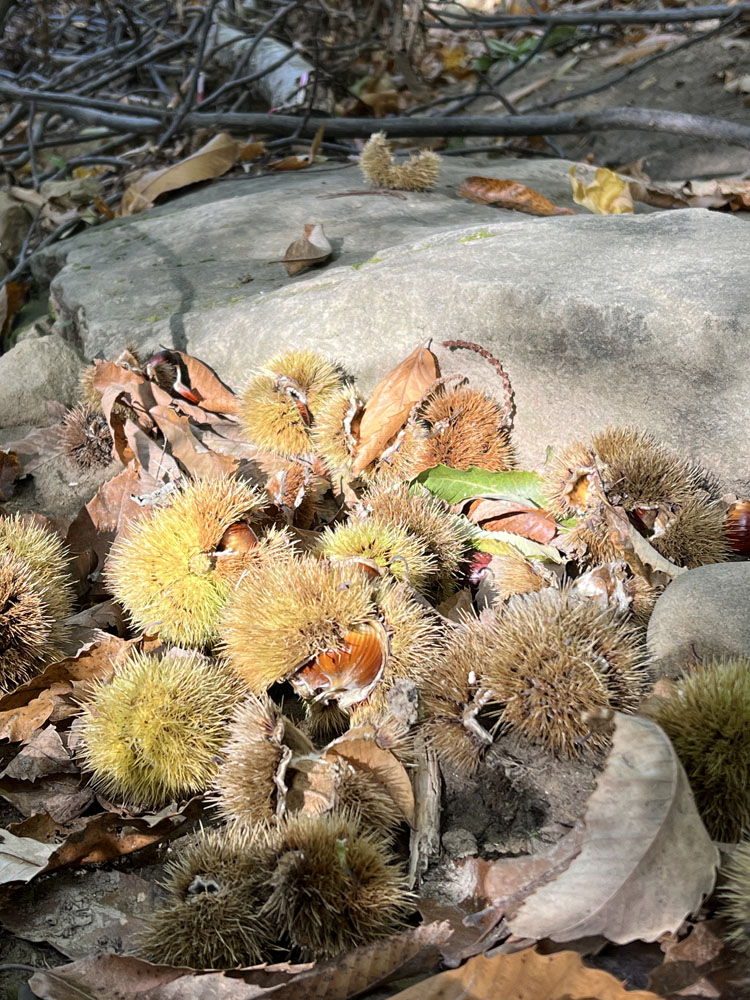
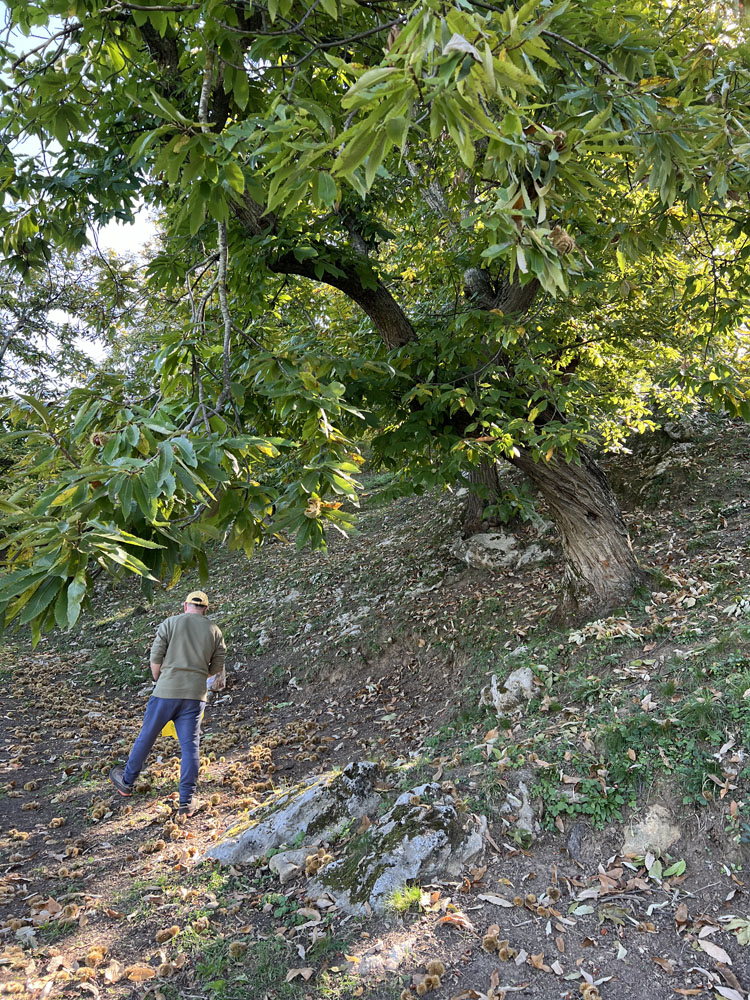
Our meeting point with Domenico’s family was in front of the church of Santa Rufina. Domenico’s mother welcomed us warmly and gave us protective hand gloves and carrier bags. Federico, his brother, guided us towards the grove. The family tends to their small farm and works the chestnut grove together. This year’s harvest started at the beginning of October. Most of the fruits had already already been collected and were stored in the meadow behind the house. The family uses bamboo sticks to take the fruits down. They are collected together with the husk – the outer spiky shell and carried down the hill in wooden baskets. They are then laid out on a flat meadow and covered with dry fern leaves. Like this, the fruits keep their moisture and thus can be sold over a longer time. Single fruits were already sorted and with the help of the grandmother were sold in small quantities. All the fruits were very beautiful. They had a dark brown colour and shiny skin. All of them had an evenly striped pattern. They looked like they had been painted.

We spent the next hours checking the ground for bigger-sized nuts, foraging the ground. Above us, the crowns of the old chestnut trees, below us some hundreds of spiky husks. There was a switch in time. We were suddenly in the midst of something else, an activity, that had been going on for hundreds of years, a tradition, that is still carried out by hand, one by one, picking, checking, throwing in the basket. It is an ancient practice, a bonding that connects humans and the cultivated ground. It’s a kind of planetary practice, that is happening on diverse local territories constantly, a practice that has never stopped existing. We were only accompanied by the sound of falling husks. This was the tiny agitation besides the breath of the wind. Randomly from one tree to another – one fell. So we always had to watch out not to be hit by the spiky bundle. This was a funny interplay. Other than that it was a very peaceful experience. We selected our chestnuts, left the husks on the ground and left the smaller nuts for the animals.


Then we were invited for lunch. Domenico’s mother is a great cook. She prepared risotto with gorgonzola, followed by fried mushrooms and homemade olive, sliced tomatoes, homemade prosciutto and pecorino, served with local wine and some bread. For dessert, we had boiled chestnuts covered with icing sugar and pastry. We sat at a table below a chestnut tree, in the garden, on a small terrace on the edge of the woods. We finished with a classic amaro, a Genziana, a bitter-sweet liqueur made by a friend of a friend. Preparing and sharing food and having a lovely conversation is one of Italians’ greatest gifts. People are talented enough to do so, just like the Cornacchia family. Deeply touched by the hospitality and happy about the hope to return one day, we continued our journey in the region.
We fell in love with the Monti della Laga. Its precise location is the triangle of Teramo, Ascoli Piceno, Ceppo and Crognaleto with numerous river valleys and scattered small villages on steep slopes connected with a network of tiny mountain roads. On the way from Teramo towards the southwest we stopped at Prati di Tivo, a famous mountain infrastructure for hiking, once skiing and now sledging. Lucky us, we were the only ones up there because the summer season was already over and the winter season hadn’t started yet. The high alpine meadows at 1450 meters altitude, are soon to be used for sledging but are now used for grazing sheep. We stayed for a little while watching the scenery and enjoying the great panoramic views. The leaves of the forests of beech trees turned reddish-yellow, a warm rusty ring of colour holding the cold silvery rocks of the high mountains. The long winter is just about to come.

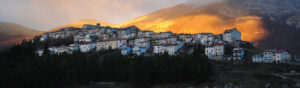
We continued our journey towards Senarica di Croganleto, a tiny village that is located in the upper valley of the river Vomano.

The valley’s landscape is the most dramatic in the region. It is narrow and covered with slopes covered with forest, a mixture of pine trees, Ash, Maples, Oaks, Hornbeam and some Poplar with extraordinary yellow foliage at this moment of the year. Then there are also chestnut trees, but most are not visible from the road. Senarica is a special place with an extraordinary history. Today, it looks however unspectacular.
The history of the place is fascinating because the village was an independent republic under the protection of the Republic of Venice for almost 400 years. They have a large forest of chestnut trees that dates back to the 15th century. During our short visit we spoke to the Azienda Agricola Sapori di Montagna and they explained to us that they collect 4 types of chestnuts and browns: One of each is wild and one of each is cultivated. They only sell the cultivated browns, the
others they keep aside and use as fodder for animals. They call their browns: Lu Nzit. It is a lighter brown colored nut with a sweet and intense flavor that is easy to peel.
They told us that all chestnut trees need to be grafted with selected species. This work was done a long time ago. The selected species were put on trees that had germinated by seed. Taking care of the chestnut trees involves the
cutting of branches that do not carry the preferable fruits and gaining a crop of excellent fruits. All chestnut trees on the European continent have experienced a difficult time over the past 50 years with the arrival of global pests, disease and the increase in temperature. For the growers it is a challenge because the terrain is steep, the trees are high, and nobody wants to use chemicals to treat the trees. Despite this over the past 10 years there has been a growing interest in the production of chestnuts, worldwide.
In the Mediterranean researchers collaborate with grower associations to discuss future projects. There is also a European network (EUROCASTANEA). The Chestnut trees are fully recognized as an important factor in the development of rural mountain areas. The many factors, that make the chestnut fruit a superfood are known to a lot of people, so it’s on us individuals to get involved in supporting those that work the land and provide us with the delicious fruits.
Read more about Erika’s urban beekeeping in Rome!

Author: Erika Mayr
Erika Mayr is a landscape gardener following Gilles Clement’s concept of planetary gardening and an urban beekeeper. I am passionate about rural life, but I have been living in cities most of my life. With bees I feel at home whereever I am.
Three years ago my partner and I moved from Berlin to Rome where I work in the park of the German Academy Rome Villa Massimo as a garden curator and beekeeper and where I have started the development of a Contemporary Care Concept. I go hiking in the Apeninnes throughout the year.