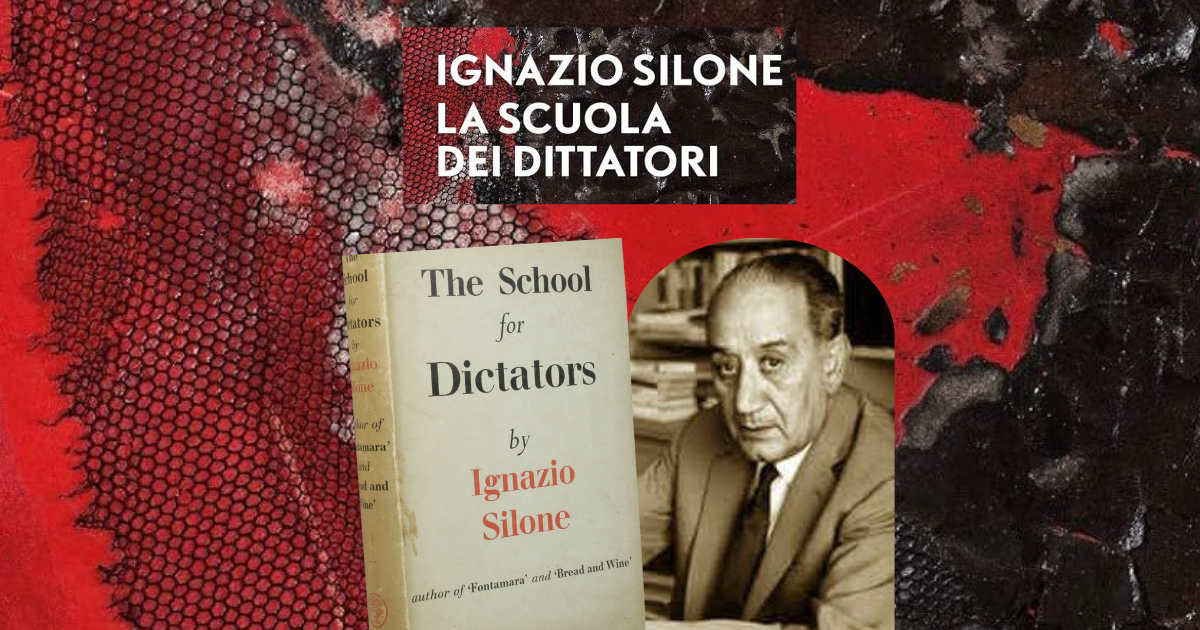
 Ignazio Silone was born in 1900 in Pescina, Abruzzo, and grew up in deep rural poverty. He lost most of his family in the 1915 Marsica earthquake and spent his youth among shepherds, peasants, and labourers, the same people who would later appear in his novels and political ideas.
Silone was an early opponent of fascism, later rejected Stalinism, and spent many years in exile. By the end of his life, no political group fully trusted him. Today, he is remembered more as a moral witness than as a party thinker.
Silone wrote La scuola dei dittatori while in exile in the spring of 1938. In 1939, it was first published in English as ‘The School for Dictators’. The book is a satirical dialogue, not a real manual, and it reveals how a dictatorship works, its anatomy; it exposes the tricks and violence that can threaten freedom, even in places that call themselves democratic.
How the Book is Structured
The book unfolds over five days, each made up of dialogues. After a study trip to Europe, two Americans arrived in Zurich: Mr Double You, thought to be America’s future dictator, and his advisor, Professor Pickup, an ideologue and creator of tautology (saying the same thing in many different ways). Their meetings with Fascist and Nazi officials taught them nothing new about taking power. Instead, they got help from Tommaso the Cynic, an Italian anti-fascist exile.
Each pertinent quotation is presented with:
- The dialogue or day (as in the index)
- The exact English quotation
- The PDF page number for the 1939 version by the Andrew Cope publishing house that can be read for free on the Internet Archive
- A plain-English explanation
1) FIFTH DAY – THE VICTORY OF THE SUBSTITUTE
- DIALOGUE XV – On the coup d’état with the assistance of the authorities
- “If an exceptional government is to be accepted, an exceptional state of affairs must be created to justify it.”
- Archive PDF: P293
- By creating or exaggerating a crisis, leaders can make people more willing to accept extreme measures or authority.
2) FOURTH DAY – TEMPTATIONS
- DIALOGUE XI – On plots and revolts without army/police support
- “In a society in a state of crisis, the democratic state is paralysed by its legality…”
- Archive PDF: P198
- During emergencies, democracy can respond slowly, and some people take advantage of that delay.
3) FOURTH DAY – TEMPTATIONS
- DIALOGUE XI
- “A telephone message from the nearest barracks is generally sufficient to bring them to heel.”
- Archive PDF: P213
- Institutions or the general public often obey when they sense that force or pressure could be used against them.
4) THIRD DAY – FASCIST PARTY POLITICS
- DIALOGUE IX – On Fascist mythology… hypnotising and subduing the masses
- “whose sole presence … is sufficient to cause terror and panic.”
- Archive PDF: P138
- A small, visible threat can scare and control an entire population.
5) THIRD DAY – FASCIST PARTY POLITICS
- DIALOGUE IX
- “That, Mr. W., is the state of grace in which Fascists are formed…”
- Archive PDF: P138
- When people experience prolonged fear and instability, they may become more open to authoritarian rule.
6) FOURTH DAY — TEMPTATIONS
- DIALOGUE X — On mistrust of programmes, ideas and formulas
- “you find it nothing but a farrago of lies and distorted half-truths.”
- Archive PDF: P170
- Propaganda is effective because it blends lies and half-truths with reality, making it hard for people to know what is true.
7) THIRD DAY — FASCIST PARTY POLITICS
- DIALOGUE VIII — On conditions making Fascist dictatorships possible
- “Fascism is a counter-revolution against a revolution that never took place.”
- Archive PDF: P114
- Authoritarian leaders often unite people by warning them about threats that are exaggerated or even made up.
8) THIRD DAY — FASCIST PARTY POLITICS
- DIALOGUE VIII
- “The birth of Fascism presupposes the following conditions: in the first place the state must be in a state of crisis…”
- Archive PDF: P114
- A crisis makes people more likely to accept authoritarian solutions because they feel more vulnerable.
9) THIRD DAY — FASCIST PARTY POLITICS
- DIALOGUE VIII
- “…many reformist leaders, who were terror-stricken by the Fascist onslaught and were inclined to compromise.”
- Archive PDF: P114
- When people are intimidated, they may give up their principles and agree to compromises.
10) FIRST DAY – THE GAME AND THE RULES
- DIALOGUE I – The author’s first encounter with Mr W…
- “repeating it three times a day to every new person you meet.”
- Archive PDF: P14
- If a message is repeated often enough, people start to accept it without questioning its truth.

Author: Sam Dunham
Sam is a freelance SEO content creator and IGCSE Geography and English teacher at Istituto Cristo Re in Rome. She also runs the Life In Abruzzo Cultural Association, sharing stories and insights about this captivating region.
Alongside raising a teenager, Sam hosts guests at her family’s traditional home, the Little House of the Firefly in Abruzzo, offering a warm welcome and insider tips on local culture, food, and hidden gems.