On 7 April 2026, something important happened. In just one sentence hidden in Law No. 34, Italy increased the population limit for its 7% flat tax regime from 20,000 to 30,000 residents. That small change has big consequences.
If you are thinking about moving to Abruzzo, this is the biggest tax update in years. Five towns that were previously not eligible now qualify. Let’s see why this change matters and how the regime works.
What is the 7% Flat Tax?
If you get a pension from abroad, or earn income from dividends, capital gains, or overseas rentals, and you have not been an Italian tax resident in the last five years, you can choose to pay a flat 7% on all that foreign income for up to ten years after moving here.
Italy’s regular tax rates range from 23% to 43%, depending on your income. The difference is big. There is no regional or municipal surtax, and you do not have to declare foreign assets. For many retirees and people living on overseas income, this is a major financial benefit.
This scheme is available in the southern Italian regions of Sicily, Calabria, Sardinia, Campania, Basilicata, Molise, Puglia, and Abruzzo. Previously, it only applied to towns with fewer than 20,000 people. Now, the scheme covers towns with up to 30,000 residents, expanding its reach.
The Five Towns Newly on the List
With the new threshold, Abruzzo adds five more towns to the list. Each offers good infrastructure, an active community, and plenty of charm. Here is a closer look at what makes each one stand out under the updated rules.
Roseto degli Abruzzi (Teramo). A proper Adriatic beach town, known for its Bandiera Blu coast, rose-lined seafront, and easy rail connections north and south. The population is around 24,000.
Giulianova (Teramo). One of the coast’s most characterful towns, with a beautiful upper historic centre sitting above a busy fishing marina. Frequent trains to Pescara and Bologna. Around 23,000 residents.
Francavilla al Mare (Chieti) is just south of Pescara, with a lively beach atmosphere and a younger population. With about 25,000 residents, it offers city access but a more relaxed lifestyle.
Ortona (Chieti). A historic port town at the start of the Trabocchi Coast, with a castle, a cathedral, and a ferry link to Croatia. It sits deep in the heart of the Montepulciano d’Abruzzo country. Around 22,000 residents, with some of the five most affordable property prices.
Sulmona (L’Aquila) is perhaps the biggest highlight of this expansion. Long among the most liveable inland cities in Abruzzo, with a well-preserved medieval centre, Sulmona is the birthplace of Ovid, famous for confetti, and borders Majella National Park. In 2025, its population was about 21,700, just above the old limit, but it now qualifies.
One Important Caveat for Abruzzo
Abruzzo is unique because it qualifies for the 7% tax in two different ways.
As a southern region, the five towns above now qualify under the 30,000 limit.
The second category comprises the earthquake reconstruction zone, known as the Cratere. This area includes specific inland municipalities impacted by the 2009 L’Aquila and 2016 central Italy earthquakes. These communities receive the tax incentive through emergency legislation overseen by the Special Commissioner for Reconstruction. This is distinct from the recently amended clause in the tax code.
The goal of that rule was always to help repopulate small, fragile villages damaged by earthquakes. Changing one part of the law does not automatically change the other. If you are considering a small inland crater town, the new 30,000 limit still needs clarification. It is important to get professional tax advice before making any decisions.
Turning to the five towns listed above that qualify under the southern region rule, the situation is straightforward.
What you Need to Qualify
The 7% tax regime does not happen automatically, and it is not a visa. You have to choose it when you file your first Italian tax return after moving. To qualify, you must:
- Receive pension or foreign-source income from outside Italy.
- Not have been an Italian tax resident in any of the past five years.
- Move your tax residence to a qualifying municipality with fewer than 30,000 residents.
- Come from a country with a tax agreement with Italy, including the UK, USA, EU countries, Canada, Australia, Switzerland, and Japan.
Once you qualify, the 7% rate is fixed for up to ten years. If your town’s population later goes above 30,000, you still keep the benefit for the whole period.
Something worth knowing before you decide
It would not be fair to only share the good news.
Abruzzo has one of the highest regional income tax rates in Italy. In 2025, the region increased its IRPEF surcharge to 3.33% for incomes over €50,000, making it one of the highest in the country, just behind Molise. This is mainly because of the regional healthcare system.
The four Abruzzo health authorities ran a certified combined deficit of around €103 million in 2024. Mid-year projections for 2025 reached €130 million before corrective measures were introduced. The most recent ministerial monitoring figures from March 2026 put the 2025 deficit at around €83 million, suggesting some improvement, though the final certified figure will not be confirmed until the ASL accounts close in mid-2026. In any scenario, the healthcare system has been running a significant structural deficit for years. The tax rise was voted through to help cover part of that gap, and a three-year plan to cut €157 million in healthcare spending is also underway.
Most of the regional budget already goes to healthcare. To cover these costs, there have been cuts to culture, transport, the environment, and local services. This pressure is not likely to disappear. The main reasons are an ageing population, years of rural depopulation, and the high cost of providing services in a mountainous region with fewer taxpayers.
It is important to see what is really happening in these five towns. The situation is not the same everywhere. Sulmona has lost about 11% of its population since 2011, dropping from 24,275 to around 21,600. Ortona has lost about 6% in the same period. These towns are truly losing people. On the other hand, Giulianova, Roseto degli Abruzzi, and Francavilla al Mare are stable or even growing a little, mostly because they are coastal towns near Pescara. They do not face the same depopulation issues. Still, the tax break applies to all five towns, whether or not they need more residents. Understanding this gives useful context before choosing where to move.
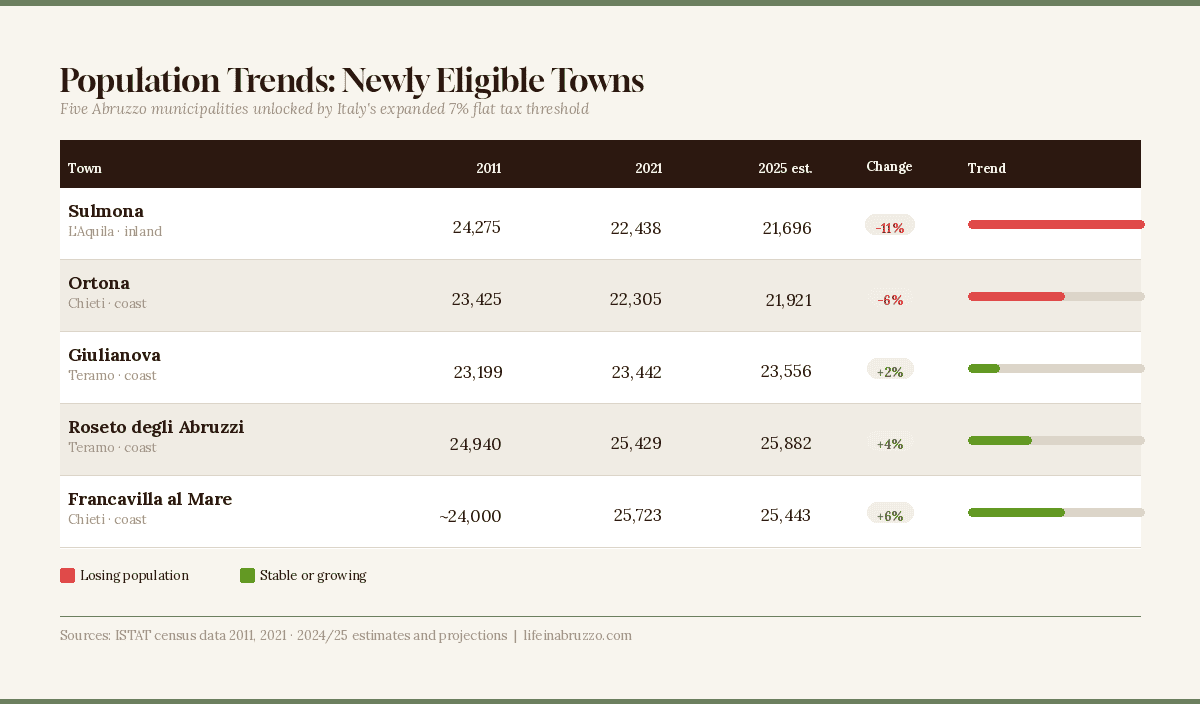
(Click here to zoom into the table)
Being on the coast does not always mean a town is stable. For example, Ortona is a busy port with a ferry to Croatia, a medieval castle, a cathedral, and a great wine region nearby, yet it is still losing people. The main reason is that, as in much of southern Italy, young people with qualifications leave for bigger cities like Pescara, Rome, or places farther north to find work. While a port town handles cargo, it creates few skilled jobs to keep young people there. By contrast, towns near Pescara, such as Giulianova, Roseto, and Francavilla, keep their populations up partly because they serve as commuter towns for the city. However, this kind of population maintenance differs from natural, real growth. That is why it is important to know the type of town you are considering before making a long-term decision.
Most users of this scheme are retirees on foreign pensions. They support local businesses but are usually older and may use more healthcare services. They rarely start businesses or hire locals, and the scheme was designed to repopulate villages rather than fix financial issues.
Here is the honest truth. The 7% flat tax on foreign income really does save money for qualifying retirees and people living on overseas income. It is a real benefit. However, it does not help fix the region’s healthcare finances or its depopulation problem. The tax you save under the 7% scheme goes to the national government, not to Abruzzo. The region’s income comes from local taxes and government transfers, and the 7% regime does not increase those amounts in any meaningful way.
An opposition councillor summed it up bluntly at the time of the IRPEF vote: “Abruzzo is not Monaco. People do not move here to pay less tax.”
Her comment was political, but there is some truth to it. Most people who move to Abruzzo and stay do not come just for a tax break. They come because the region is special, the landscapes, the food, the pace of life, and the feeling of belonging to a place that is not made for tourists. The tax benefit is just a bonus, not the main reason.
If you move here for the right reasons, you will love it. But if you come mainly for financial reasons, you might find that rural Italian bureaucracy, uneven healthcare, and limited public services are more challenging than you expected. The Abruzzo Insiders Club exists precisely to give you the real picture, not just the appealing one.
Is this the moment? After weighing these factors, you may wonder if this is your time to make the move.
For years, people have admired Abruzzo from afar, the landscapes, the food, the coast and mountains so close together, the relaxed pace of life, and the affordable property. Raising the limit to 30,000 residents now opens up some of the region’s most attractive towns.
If you have been considering a move, you now have more choices than ever. Just make sure you know what to expect.

Author: Sam Dunham
Sam is a freelance SEO content creator and IGCSE Geography and English teacher in Rome. She also runs the Life In Abruzzo Cultural Association, sharing stories and insights about this captivating region. Alongside raising a teenager, Sam hosts guests at her family’s traditional home, the Little House of the Firefly in Abruzzo, offering a warm welcome and insider tips on local culture, food, and hidden gems.