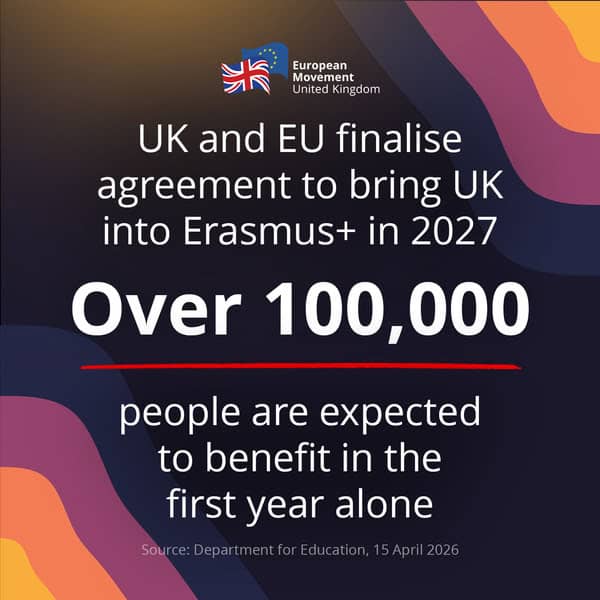
In April, the United Kingdom and the European Union signed an agreement that will bring Britain back into Erasmus+ starting in January 2027. After five years away, British students will once again be able to spend part of their studies at European universities, and European students can do the same in the UK. The European Commission expects over 100,000 people to join in the first year.
This change is important for Abruzzo. The region’s universities are more internationally connected than many people realise, with several already having long-standing partnerships with British institutions. Erasmus+ does not create these connections; it funds and formalises them, making study abroad possible for students whose families might not otherwise be able to afford it.
What Abruzzesi Students Get Back
Erasmus+ exchanges last from three months to a full year. The grant goes to the home university, not directly to the student. Academic credits transfer automatically, so time spent at places like Edinburgh or Durham counts toward a degree at L’Aquila or Chieti. The program covers travel and some living costs, with extra support for students from lower-income families.
In practical terms, Abruzzesi students at all levels will once again have access to one of the world’s most respected higher education systems. Whether undergraduate, master’s, or doctoral, opportunities open up. For example, a medical student at D’Annunzio can spend a semester at a British teaching hospital. A physics doctoral student at the Gran Sasso Science Institute can formally collaborate with Edinburgh, where a joint research group already exists. A language student at Chieti-Pescara can study at York, which has partnered with D’Annunzio for years. A veterinary student at Teramo can train in a British practice. Without Erasmus+, most of these experiences would be out of reach for families who are not already wealthy.
Now is the time to act. Italian universities will plan their 2027-28 partnerships during spring 2026, and applications will open in February. Students who want to be among the first to go to Britain should contact their Ufficio Relazioni Internazionali this academic year, not wait until next year.
What the Region Offers in Return
The other side of Erasmus+ is welcoming students from abroad. Starting in 2027, British universities will again send their students to European partners. Abruzzo has much more to offer than many in Britain might realise.
The University of L’Aquila is well known internationally for its work in earthquake engineering and seismic microzonation, a reputation built over forty years and strengthened after 2009. Its physics faculty collaborates directly with the Laboratori Nazionali del Gran Sasso, where research on neutrinos, dark matter, and astroparticles is conducted underground. The Gran Sasso Science Institute, founded in 2012, offers four doctoral programs in English and is considered one of Italy’s most international graduate schools.
The University of Teramo has European accreditation for veterinary medicine, a distinction held by only a few Italian veterinary schools. It is also well regarded nationally for food science and oenology. The University of Chieti-Pescara has partnered with Oxford, Durham, Leicester, and the British School at Rome since 1994. The Sangro Valley project explores Samnite hilltop sites near Lanciano, and the university’s biomedical research, especially on ageing, is recognised internationally.
These universities are not just local institutions relying on regional appeal. They are serious schools with specialised strengths that British students can benefit from. Living in the region also costs much less than in cities like Florence or Bologna.
Why This Matters for the Region
Students who return from studying abroad bring back more than just academic experience. Some British students who came to Italy on Erasmus before 2021 stayed connected after returning home. Many came back as researchers, collaborators, journalists, or long-term visitors. Some even settled in Italy. Erasmus is more than a study program; it is one of the most effective ways for small regions to become known to young, educated Europeans.
This matters for Abruzzo. The region has worked hard to attract residents, students, and visitors seeking more than just a holiday. Erasmus+ is a gradual, steady way to do the same. It places Abruzzesi students in British classrooms and brings British students to Abruzzo, hoping that some will keep these connections as they move forward in life.
The universities have always been here. What changes in January 2027 is that funding and the structure will be available again, enabling exchanges in both directions.

Alongside raising a teenager, Sam hosts guests at her family’s traditional home, the Little House of the Firefly in Abruzzo, offering a warm welcome and insider tips on local culture, food, and hidden gems.

Author: Sam Dunham
Sam is a freelance SEO content creator and IGCSE Geography and English teacher in Rome. She also runs the Life In Abruzzo Cultural Association, sharing stories and insights about this captivating region. Alongside raising a teenager, Sam hosts guests at her family’s traditional home, the Little House of the Firefly in Abruzzo, offering a warm welcome and insider tips on local culture, food, and hidden gems.